
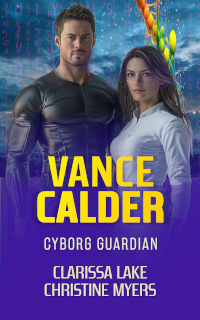
Episodes 1 -3: He was sent to destroy the threat.
She turned out to be his genetic mate.
Follow the Vance Calder Serial
New episodes of this Cyborg Guardian story are released regularly.
📬 Newsletter subscribers receive new chapters first.
Join the newsletter and follow the story as it unfolds.
VANCE CALDER
Episode One: The Assignment
Vance
Nova Hollow slept.
From the perimeter ridge, I watched the settlement lights burn low and steady, each one marking a home reclaimed from the ruins of the old world. The night air was cold and clean, carrying the distant hum of generators and the softer, human sounds of laughter drifting from the communal hall.
My sensors catalogued everything automatically — temperature, wind patterns, energy fluctuations — but my attention remained fixed on the town below.
Peace had been hard-won here.
Eight years ago, there had been nothing but rubble and radiation. No infrastructure. No law. No future. I had helped change that. I had bled for it, killed for it. Guarding Nova Hollow was a task I executed flawlessly, as expected.
Yet even after all this time, I remained apart from it.
Cyborgs did not integrate the way humans did. Not fully. We were protectors, not participants. We stood at the edges of communities so others could live at the center.
“You’re thinking too hard again.”
Daken’s voice came from behind me, calm and familiar. I turned, acknowledging my commander with a slight inclination of my head. Selene stood beside him, her presence warm in a way my systems could register but not replicate. The bond between them was unmistakable — steady, grounded, alive.
I logged it as an anomaly. I always did.
“Status unchanged,” I said. “No perimeter breaches. No external threats.”
“I didn’t ask for a report,” Daken replied mildly. His gaze lingered on the settlement lights before returning to me. “Command’s sending you out.”
That was unexpected.
“Details?” I asked.
“There’s a facility in the southern wastelands,” he said. “Pre-war research site. Long thought inactive. It isn’t.”
A data packet was transferred to my internal processors. Location. Environmental hazards. Structural integrity. The surrounding terrain was hostile and largely uninhabited.
It flagged isolation as a primary risk factor.
“Why me?” I asked.
“Because you’re the best choice,” Selene said quietly. “And because it needs to be handled cleanly.”
Daken met my eyes. “This is a solo assignment.”
The word locked into place with finality.
Solo missions were rare now. Guardians worked in teams, supported by rebuilt command structures and local militias. Sending a cyborg alone meant the threat was either minimal—or catastrophic.
“What is the nature of the threat?” I asked.
Daken hesitated. Only briefly, but long enough for me to register it.
“Unknown,” he said. “We know something dangerous is contained there. We know it can’t be allowed to spread. And we know there’s one human still inside.”
A human.
Alive.
A faint, unfamiliar tension registered beneath my chest plating. “Orders?”
“Assess. Contain. Neutralize if necessary,” Daken said. Then, more quietly, “If there’s another way, you’ll find it.”
I nodded once. I did not ask about extraction timelines or support contingencies. There were none.
“I leave at first light,” I said.
Daken clasped my forearm. Selene’s gaze held something like sympathy — or warning.
As I turned back toward the dark horizon, my systems shifted into mission mode. Targets. Objectives. End states.
I did not yet know that the facility held more than a threat.
I did not yet know that everything I understood about duty, survival, and myself was about to change.
Thea
The alarms had been quiet for six hours.
That alone should have unsettled me.
I stood at the central console, hands braced against the cold metal edge, eyes scanning readouts that had become too familiar over the past eight years. Every fluctuation, every warning spike, every tiny variance in output lived in my bones now. I felt them before I saw them.
The system was holding.
Barely.
I exhaled slowly and forced my shoulders to relax. Panic never helped. Panic led to mistakes, and mistakes here meant extinction.
My parents had taught me that.
I reached up and brushed my fingers over the worn edge of the console, the surface smoothed by generations of hands — theirs, then mine. They had designed this place to save the world. I had inherited it when they died, and I made sure it worked.
No pressure.
The facility was silent except for the low hum of power cycling through reinforced conduits. No sunlight reached this deep underground. Time passed differently here, measured in output levels and containment stability rather than hours or days.
I checked the secondary monitors. Containment integrity remained within acceptable thresholds, but the margins were shrinking. They always were.
I could hold it.
I had to.
Above me lay a world that had already lost too much. Cities erased. Populations scattered. Humanity was clinging to survival one settlement at a time. If what I guarded here escaped, there would be no rebuilding. No second chances.
Just silence.
I straightened and pulled my shoulders back. Exhaustion was a luxury I couldn’t afford. I chose to stay when evacuation orders were issued years ago. I had chosen to shoulder this burden alone.
Because if I didn’t, no one else could.
A sharp tone cut through the quiet.
I froze.
The alert pulsed again — external perimeter breach.
My heart slammed against my ribs as I spun toward the security display. Motion signatures registered at the outer access points. Armed. Human.
Raiders.
“Of course,” I muttered.
My fingers flew across the controls, initiating lockdown protocols. Doors sealed. Barriers rose. The facility groaned faintly as ancient systems strained under renewed demand.
The containment field flickered.
“No,” I whispered. “Not now.”
I rerouted power manually, sacrificing auxiliary systems to stabilize the core. The lights dimmed, plunging the chamber into a deeper, harsher glow.
The outer alarms blared louder.
They were getting closer.
I swallowed hard and forced myself to breathe. I had prepared for this. I had contingency plans stacked on contingency plans. What I didn’t have was backup.
I had never expected to need it.
The proximity alert screamed.
The outer door began to cycle.
I stared at the monitor, pulse roaring in my ears, as the security feed resolved into a single, unmistakable figure.
Tall. Armored. Metallic.
A cyborg.
The door hissed open.
And he stepped inside.
To be continued…
VANCE CALDER
A Cyborg Guardian Serial
Episode Two: The Intruder
Thea
The cyborg filled the doorway like a walking wall of armored metal and lethal intent.
For a second, all I could do was stare.
He was taller than I’d expected—even for a cyborg—with broad shoulders encased in matte-black plating that caught the harsh overhead light. The helmet retracted with a soft hiss, revealing a human face beneath the metal: strong jaw, sharp cheekbones, eyes the color of storm clouds over ash.
Not a raider, then.
Somehow, that didn’t make me feel any safer.
My pulse hammered against my ribs, too fast, too hard. Adrenaline, I told myself. Eight years with nothing but containment metrics and old logs for company, and now I had armed intruders on the surface and a cyborg Guardian standing in my control room.
This was not in any of my contingency plans.
“Identify yourself,” I said, amazed that my voice came out steady. “And state your purpose here.”
His gaze swept the room once, taking everything in—consoles, conduits, the faint shimmer of the containment field—and finally settled on me. For a heartbeat, something like surprise flickered in his eyes.
Then his expression went neutral again, unreadable.
“Vance,” he said. His voice was low and even, with the faintest mechanical undertone. “Cyborg Guardian, Civil Restoration Command.”
Civil Restoration.
I exhaled a breath I hadn’t realized I was holding. Not raiders. Not Mesaarkans. Not another loose-minded warlord looking for a new toy.
Still dangerous, though.
“What are you doing here, Guardian?” I asked. “This facility is restricted.”
“Command registered anomalous activity,” he replied. “I was deployed to assess and contain any active threat.” His gaze slid toward the main containment readouts. “Your facility appears to be the source.”
“I’m the one keeping the threat contained,” I shot back. “You’re late.”
The words slipped out before I could stop them, edged with fatigue and eight years of bone-deep frustration. I’d waited for help that never came. Learned not to expect it.
His eyes returned to me, studying my face with unnerving intensity. My skin prickled, heat spreading up the back of my neck.
He took a step forward.
My body reacted before my brain caught up—tightening, bracing. The scent of him reached me: metal, and something warmer beneath it, like sun-heated skin and ozone.
My heart did a strange, stuttering skip.
Definitely adrenaline.
“Stop there,” I said, lifting a hand. “Cross that line, and you risk destabilizing my field.”
It wasn’t entirely true. The containment systems didn’t care where he stood, as long as he didn’t start ripping out hardware. But I needed space to think, and distance to breathe.
He halted immediately, boots braced on the scuffed deck plating just short of the faded caution stripe.
“I’m not here to interfere with your work,” he said. “I’m here to determine whether it can continue safely.”
“You have no idea what this place is, do you?” I asked.
“Not yet.”
His honesty startled me. Most officials I’d dealt with in the early years had spoken in careful half-truths and evasions. Vance looked me in the eye and gave me the simple, unvarnished answer.
It shouldn’t have made my chest feel tight.
Outside, a distant rumble shook the walls. Dust sifted down from the overhead supports. My fingers curled around the console.
“Raiders are probing the outer access points,” I said. “If they breach the inner levels, we’ll have a bigger problem than whether Command checked the right boxes on your mission brief.”
Vance’s head tipped slightly, listening to data I couldn’t hear.
“Multiple heat signatures,” he confirmed. “Lightly armed. No heavy ordnance detected.” His gaze sharpened. “Their presence increases risk to containment.”
“No kidding,” I muttered.
The containment field flickered again at the edge of my vision. I turned back to the controls, my hands moving through familiar sequences, rerouting power and compensating for stress fractures in ancient conduits. I didn’t realize Vance had moved closer until the hairs on my arms stood on end.
“I thought I told you to stay back,” I said without looking up.
“I calculated I could advance one point four meters without compromising structural safety,” he replied. “And it increases my ability to intercept hostiles if they breach this level.”
“Congratulations,” I said dryly. “You’ve reached the edge of my comfort zone.”
I finally looked at him.
Big mistake.
Up close, his eyes were even more intense—cool gray ringed by the faintest rim of pale blue, framed by short dark lashes. There were faint lines at the corners, the kind that spoke of too little sleep and too much battlefield.
Something inside me… shifted.
My breath caught. For a dizzy heartbeat, the world narrowed to the sound of his pulse—steady, powerful—and the subtle hum of systems beneath his skin. A warmth bloomed low in my abdomen, tinged with something like recognition.
Absolutely adrenaline.
I forced my attention back to the readouts. “Listen, Guardian. Whatever Command sent you here to do, the only way the world survives is for that containment field to stay intact. Everything else is secondary, including me.”
Silence stretched for a second.
When he spoke again, his voice was softer. “That is not how I calculate priorities.”
I didn’t have time to unpack that.
The alarms spiked, shrill and insistent. The outer defensive grid had failed in one sector. They were closer now—too close.
“I have to focus,” I said. “If you’re going to help, keep the raiders out of my way. Don’t touch anything on this console without my explicit instruction, and don’t fire any energy weapons near the core. Clear?”
“Understood,” he said.
I could feel his gaze on me as I worked, rerouting power, reinforcing failing nodes, coaxing an overtaxed system to hold on just a little longer. My hands moved on instinct—my parents’ training, my own modifications, eight years of patchwork and stubbornness.
The pressure built behind my eyes. I blinked hard, refusing to let it turn into tears.
I could not afford to fall apart in front of this man. Machine. Both.
Whatever he was, his presence shouldn’t have left my body keyed up and hyper-aware. It shouldn’t have made me wonder what his hands would feel like without gloves or how his voice would sound if he said my name.
I didn’t even know if he knew my name.
He will, a quiet, treacherous voice whispered.
I shut it down and focused on the numbers.
Vance
I had been in countless war zones.
I had walked through the ruins of cities and across battlefields littered with the dead and dying. I had faced Mesaarkan shock troops, rogue militias, and feral scavenger packs. My systems were designed to process chaos and calculate the most efficient way to neutralize it.
This felt different.
The facility’s core hummed like a live thing beneath my feet, power surging and dipping in restless currents. The air tasted of ozone and recycled dust. The raiders on the surface were a known variable—predictable, containable.
The woman at the console was not.
My HUD tagged her immediately when I stepped through the door:
HUMAN: FEMALE. AGE RANGE: 28–35. VITAL SIGNS: ELEVATED.
Then another line of data overlaid the first, flashing in urgent gold:
GENETIC MATCH DETECTED.
The rest of the room had faded for a fraction of a second.
I knew what that designation meant.
Every cyborg did.
Genetic mate. Hard-coded at creation. A single person whose presence would trigger dormant programming—bonding subroutines and protective directives that overrode standard priorities.
I had never expected to encounter mine.
Statistically unlikely given our reduced numbers and scattered populations. Strategically incompatible with my designated function.
Yet here she was.
Thea. Her name appeared on an old personnel file as my systems dug deeper:
DR. THEA KOVAR, LEAD SYSTEMS ENGINEER, FACILITY K-23. File outdated. Status: unknown until now.
Status: standing in front of me, her jaw set and shoulders tight, holding the fate of the world together with her bare hands and refusing to ask for help.
My help.
I watched her move between consoles, her fingers flying over the controls with practiced precision. Her hair was pulled back in a no-nonsense knot, with a few strands escaping to brush the nape of her neck. There were shadows under her eyes and tension in the line of her mouth, but her focus never wavered.
She was exhausted. She was afraid.
She was still standing.
The bond signature pressed against my awareness like a low-level electrical charge. My systems pinged it, recognized it, and began quietly reconfiguring parameters around it.
Primary objective: protect my genetic mate.
It slotted itself alongside my other mission directives as if it had always been there, waiting.
Outside, another explosion shook the structure. Thea flinched, then forced herself still.
“Outer grid failure in sector four,” she said tightly. “If they find the right access point, they could get inside before I can reroute power.”
“I won’t allow that,” I said.
She gave a short, humorless laugh. “You planning to be everywhere at once?”
“If necessary.”
Her mouth twitched, as if she wanted to argue but couldn’t spare the energy. I stepped half a pace closer, staying on my side of the caution line she’d drawn.
“You’ve been alone here a long time,” I said. It wasn’t a question.
She didn’t look away from the console. “Since my parents died. Since Command decided this facility was easier to forget than to support.”
“That decision was incorrect,” I said.
“Glad we agree,” she muttered.
Another flicker in the containment field registered on my sensors. My processors threw up worst-case projections: breach, cascade, planetary-level contamination.
Neutralize if necessary.
The words from my mission brief echoed in my memory.
If the containment failed, there would be an argument—no, an order—from Command to destroy whatever remained. Including her.
My jaw clenched.
I rejected that projected outcome.
“Your containment design has held for eight years,” I said. “What changed?”
“Age. Stress. Entropy.” Her fingers danced over the controls, making minute adjustments. “The system wasn’t built to be patched forever. It needs upgrades. Reinforcements. A full team.” A bitter edge crept into her voice. “Instead, it got one overworked engineer and a pile of promises no one kept.”
Her heart rate spiked as she spoke. Not just from anger. From the constant strain of being the only line of defense.
Protective protocols nudged at me, pushing for physical reassurance—contact, closeness, anything that might lower her stress levels.
I stayed where I was.
If I crossed that line, I might not want to step back.
“Command is aware now,” I said. “That changes the equation.”
“You think?” she asked, cutting me a sharp look. “Tell me something, Guardian—if they decide this place is too dangerous to keep running, what happens to me?”
I met her gaze steadily. “That decision will not be made without me.”
“That doesn’t answer my question.”
No, it didn’t. Because the honest answer was unacceptable.
You die if this fails.
I would sooner tear the world apart myself.
The bond flare intensified, reading as a low, insistent pressure in my chest, in the base of my skull. My focus narrowed on her face, on the small muscle jumping in her jaw, on the fine tremor in her hands that only someone like me would notice.
She was my mission now.
Not instead of the world. Alongside it.
She turned back to the console, shoulders squaring under a weight she’d carried too long. Something inside me settled around the shape of her, as if a puzzle piece had clicked into place.
She was mine.
I drew a steadying breath.
“Thea,” I said.
She glanced up, eyes wide, startled that I’d used her name.
“How do you know—”
“My systems identified you when I entered.” I stepped across the faded caution stripe before I could talk myself out of it. Her breath caught, but she didn’t move away. Good. “There is something you need to understand.”
Her throat worked as she swallowed. “If you’re about to tell me Command has decided I’m expendable—”
“No.” My voice came out sharper than intended. I softened it. “That is not what I’m about to tell you.”
The moment stretched between us, charged and fragile. Raiders pounded at the outer edges of her world. The containment field hummed dangerously close to its limits.
There would be time for full explanations later. For now, she needed one clear truth.
I held her gaze.
“You aren’t expendable, Thea,” I said quietly. “Not to me. Because whether you realize it yet or not…”
I let the words fall, irrevocable.
“…you are my genetic mate.”
VANCE CALDER – Cyborg Guardian Serial
Episode Three: Fault Lines
Thea
For a second, I honestly thought I’d misheard him.
The alarms were still screaming, the floor still trembling with distant impacts, the containment field a faint, unstable shimmer at the edge of my vision. My brain tried to prioritize—warning sirens, power levels, raider positions—and instead snagged on two words.
Genetic. Mate.
I stared at him. “You’re joking.”
Vance didn’t even blink. “I am not.”
Of course, he wasn’t. Cyborgs weren’t known for their sense of humor.
Heat flooded my face, a sharp, confusing mix of anger and something dangerously close to panic. I stepped back, placing the console between us like a shield.
“No,” I said. “Absolutely not. Whatever your programming says, I’m not—”
The containment field flickered.
Damn it.
I spun back to the controls and slammed a hand down on the manual stabilizer. The readings jittered, then steadied, leaving a faint ache behind my eyes.
“You picked a hell of a time for this conversation,” I said through my teeth.
“I agree,” Vance said calmly. “However, the data is relevant to mission parameters.”
“Mission parameters,” I repeated, a little wild. “Your mission was to come here, assess the threat, and… what was it? ‘Neutralize if necessary’?”
His silence was answer enough.
I let out a harsh laugh. “Right. Well, now you’ve added ‘claim genetically assigned life partner’ to the to-do list, so congratulations, you’re overachieving.”
“My intention is not to claim you,” he said.
Something in his voice made me look up.
He stood very still on the other side of the console, hands loose at his sides, like a man trying very hard not to spook a cornered animal. His gaze was steady, but there was a tension around his mouth I hadn’t seen before.
“What do you want me to say?” I demanded. “That I’m flattered Command decided I belong to one of their weapons?”
“I am not—”
“You are,” I cut in. “At least partly. You said it yourself, you were deployed. You follow orders. And now you’re telling me there’s… code in your head that says I’m yours?”
“Yes,” he said simply.
The honesty hit harder than any polished denial would have.
I gripped the edge of the console until my fingers ached. “Do you hear yourself? Do you understand what that sounds like from my side of this equation?”
“I understand it sounds coercive,” he said. “It is not meant to be. The bond exists whether we acknowledge it or not. What we do with it is our choice.”
“Is it?” My throat felt tight. “Because I didn’t sign up for this. I didn’t ask for a cyborg, or a mate, or… any of it. I volunteered to keep the world from ending. That’s enough of a lifetime commitment for me.”
“You didn’t ask for eight years of isolation either,” he said quietly.
My chest constricted. “Don’t you dare use that against me.”
“I am not using it against you,” he said. “I am stating facts. You have been alone too long. You are overextended. You are in danger. Those factors matter to me, regardless of what you choose to do with the bond.”
The conviction in his tone made my skin prickle.
I dragged a hand through my hair, fingers snagging on loose strands. “You don’t get to walk in here with your mission and your programming and tell me my life just changed because some line of code lit up when you saw my face. That’s not how this works.”
He inclined his head slightly. “Then tell me how you want it to work.”
The question stole my breath.
No one had asked me that in… years. Not since my parents died. Everyone else had told me what I was supposed to do. Stay. Maintain. Sacrifice. Be the thin line between survival and oblivion.
There had never been room for want.
The floor shuddered under another impact. Dust rained down from high support beams, powdering the edges of the consoles.
I didn’t have time for this.
“Right now?” I said. “I want the containment field stabilized and the raiders gone. We’ll deal with your bond issue if and when the world isn’t about to end.”
His jaw flexed, but he nodded. “Acceptable prioritization.”
“Glad we agree.”
The alarms shrieked in my ears, spiking to a higher pitch. A new warning flashed on the far panel—inner perimeter breach, level three.
They’d made it past the outer defenses.
“Damn it.” I sprinted to the security console, pulling up live feeds. Grainy images flickered to life: armed men moving through a narrow access corridor, flashlights cutting through the gloom.
“They found an old maintenance shaft,” I said. “Of course they did.”
Vance stepped up beside me, his presence a heavy, grounding weight at my shoulder. “You have internal defenses on that level?”
“A few,” I said. “Mostly non-lethal. They weren’t designed for this many people, and I can’t divert more power without—”
The containment field gave a low, ominous thrum, as if it could hear me.
Without that.
“Show me their route,” Vance said.
I swept a finger along the schematic overlay. “If they keep going straight, they’ll hit an auxiliary lab—no direct access to the core from there, but they could damage support systems. If they turn here—” I tapped a junction. “—they’ll come out on this catwalk two levels up.”
“Position in relation to us?” he asked.
“Above and to the east,” I said. “They’d have line of sight into the chamber if they get that far.”
“Then they won’t get that far.”
He turned away from the console, helmet sliding back into place with a hiss.
“Where are you going?” I demanded.
“To engage,” he said. “You said you needed the raiders out of your way.”
“I said that,” I snapped, “but I didn’t say you should rush into a crossfire alone. They have numbers. You don’t know the layout li Yeah ke they do.”
“I’m learning it,” he said. “And numbers will not help them where I’m going to meet them.” His visor dimmed, sensors spooling up. “Lock any doors you can behind me. Limit their options.”
“Vance—”
He paused at the threshold.
“I heard you, Thea,” he said. “About choice. We can argue about genetic bonds later. For now, let me do what I was built to do.”
My throat tightened.
“Fine,” I said. “But if you die in some side corridor after dropping that on me, I will be very annoyed.”
“Noted,” he said.
Then he was gone, all heavy footfalls and cold efficiency, heading toward the nearest service access like he’d been born in these halls.
The door sealed behind him with a solid, echoing thud.
I let myself lean against the console for a heartbeat, just one. My legs felt shaky. My hands did too.
Pretty sure that wasn’t just adrenaline anymore.
“Get it together, Kovar,” I muttered. “You can have the breakdown after you save the world.” The containment field flickered again, as if in agreement—or warning.
I straightened and got back to work.
Vance
The corridors smelled of dust, old metal, and the faint, sour tang of human sweat that didn’t belong to Thea.
I moved fast and silently through narrow passageways, following the heat signatures scrolling along my HUD. The raiders had forced open a maintenance hatch half a kilometer from the main chamber—improvised breaching tools, brute force, no subtlety.
They had no idea what they were walking into.
My processors ran projections as I moved. Twenty-three hostiles. Light to medium arms. No heavy explosives detected. If that remained true, the structure could handle a localized firefight.
If.
“Vance, talk to me,” Thea’s voice came through the comm channel, thin with static but clear enough. “They just hit another junction. I’ve sealed off the lower route.”
“Visual acquired,” I said.
I eased up to the edge of a cross-corridor and looked down.
A cluster of raiders advanced cautiously, weapons raised, flashlights cutting jerky beams through the gloom. They wore scavenged armor, patchwork gear, the desperate look of men who had spent too long fighting over scraps.
They did not move like trained soldiers.
I stepped out.
For one suspended moment, we all froze, staring at each other.
Then someone shouted, “Cyborg!” and opened fire.
Bullets pinged off my chestplate and shoulder armor, sparking against the walls. I adjusted my stance, calculated angles, and moved forward deliberately, absorbing the barrage. My HUD highlighted weapon types, trajectories, and threat levels.
Their aim was poor. Their tactics worse. They tried to fan out in a hallway too narrow to support it.
I fired twice, low and precise, taking out knees instead of skulls. Two men went down screaming. The others hesitated, startled that they were still breathing.
“Last warning,” I said, voice amplified through the helmet. “Drop your weapons and retreat. This facility is off-limits.”
They answered with more wild gunfire and a grenade arcing toward me.
That changed the equation.
I lunged forward, grabbed the nearest raider, and used his body as a shield as the grenade detonated behind us. The blast rattled my internal gyros, shuddered through the walls, and sent a hot shockwave searing across the nanite armor covering my neck. Although I felt the heat, I felt no pain.
“Vance!” Thea’s voice snapped in my ear. “What the hell was that?”
“Minor detonation,” I said. “No structural breach detected. Continue your work.”
“You’re insane,” she muttered.
Possibly.
The raiders had been thrown into disarray by their own explosion. I used the opening, moving in close, my fists doing most of the work. Metal met flesh and bone with sickening thuds. I went for disabling blows—joints, weapon arms, solar plexuses.
I did not kill unless I had to.
Thea’s heart rate spiked on my HUD when one of the raiders got a lucky shot past my guard, and a bullet ricocheted off the side of my helmet. The impact barely registered, but her sharp intake of breath did.
She was listening.
I finished the last of them with a sweep of my leg, taking three down at once. Groans echoed in the corridor. Weapons clattered to the floor.
I scanned them quickly. No one was dead. Many wouldn’t be getting up again soon.
“Primary incursion neutralized,” I reported. “I’ll secure their gear and—”
A new alarm chimed across my sensors.
“Vance,” Thea said, her voice suddenly too calm. “We have a problem.”
“I am listening.”
“That explosion you shrugged off like it was nothing?” she said. “It jolted one of the auxiliary conduits. I’ve got a power spike feeding back into the containment buffer.”
My internal projections updated, with the numbers shifting toward the red.
“How bad?” I asked.
She hesitated. “If I redistribute load through the normal channels, we lose shielding in three other places. If I don’t, we overload the containment matrix.”
“And the alternative?” I asked.
Silence. I could almost hear her thinking.
“Reroute through a grounded conductor,” she said finally. “Something that can take a stupid amount of energy very quickly and not vaporize.”
“You have such a conductor available?” I asked.
Another tiny pause.
“Yes,” she said. “I do.”
“Where is it?” I asked.
She blew out a breath. “You.”
I stopped.
“My systems can handle high-voltage surges,” I said slowly. “But if you’re wrong about the load—”
“If I’m wrong, it could fry your neural interface,” she said bluntly. “Or your heart. Or both. I don’t have time to pretty it up, Vance.”
For a human, her voice was remarkably steady.
I pictured her at the console—jaw set, eyes shadowed, fingers moving over controls that had become extensions of herself. Eight years of standing between this thing and the world, waiting for help that never came.
Help that might kill itself for her now.
The bond pulsed, a low, steady drumbeat under my sternum.
“You are certain this is the best option?” I asked.
“I’m certain it’s the only option that doesn’t end with a global extinction event,” she said. “But I can’t… I won’t force you to act as a living lightning rod for my mistakes. If you say no, I’ll find another way.”
There was no other way. We both knew it.
I started moving, boots pounding back toward the main chamber. “Tell me where you need me.”
Silence again, but this time it felt different. Warmer. Scared.
“Central conduit,” she said. “There’s a transfer node just off the main platform. If you brace yourself there, I can divert the worst of the surge through your system and bleed it off before it destabilizes the core.”
“Understood.”
“Vance?”
“Yes, Thea.”
“I need you to listen to me very carefully,” she said. “Because if I miscalculate even a little, this will kill you.”
I reached the last door between us and palmed it open, stepping into the chamber where she stood—small and fierce against the glow of the containment field, eyes too bright.
I met her gaze through the visor.
“Then proceed,” I said.
To be continued…
Next Transmission
The situation at the lab facility is becoming unstable.
Raiders are closing in, Command is questioning whether the facility should be destroyed, and the bond between Vance Calder and Thea Kovar is becoming impossible to ignore.
In the next episode, Vance will have to make a choice that could change both their futures—and the fate of Nova Hollow.