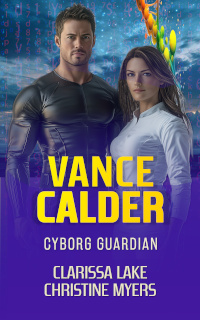
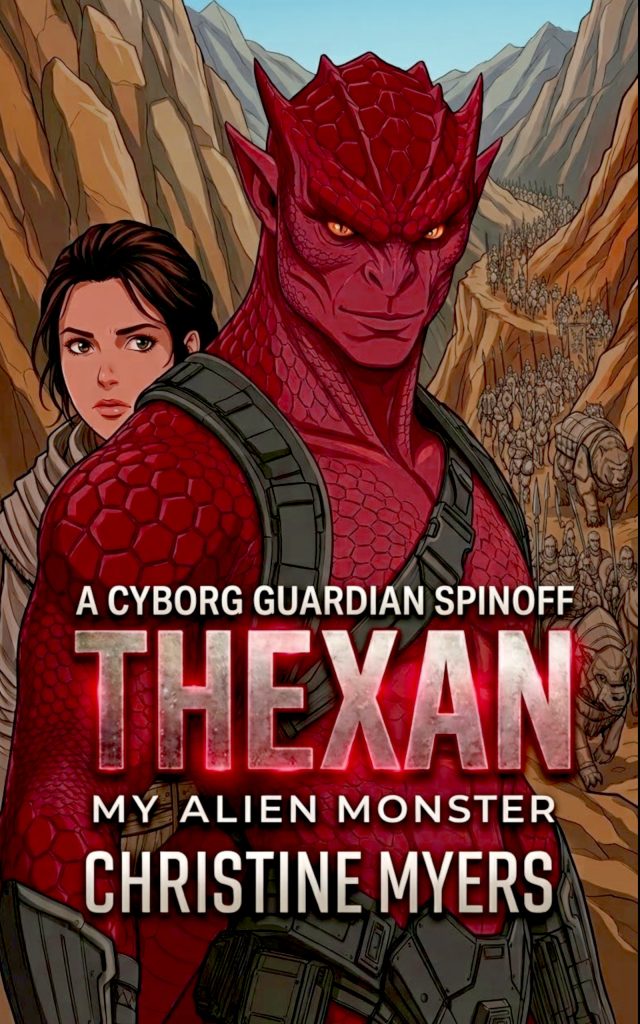
Thexan: My Alien Monster

Sample Chapters

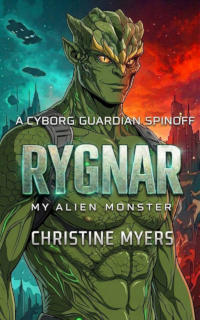
Thexan: My Alien Monster Book Cover

Releases to Kindle Unlimited on September 24th.

Chapter One

Brynn

The wound should have closed hours ago.

I pressed the folded cloth more firmly against his side and watched the blood seep through it anyway, darkening the fabric in slow, stubborn saturation. It didn’t surge the way a fresh injury might. It didn’t pulse cleanly with his heartbeat. It simply continued, steady and unrelenting, as though his body had forgotten how to stop.

“Stay with me,” I said quietly, more out of habit than expectation.

He didn’t respond.

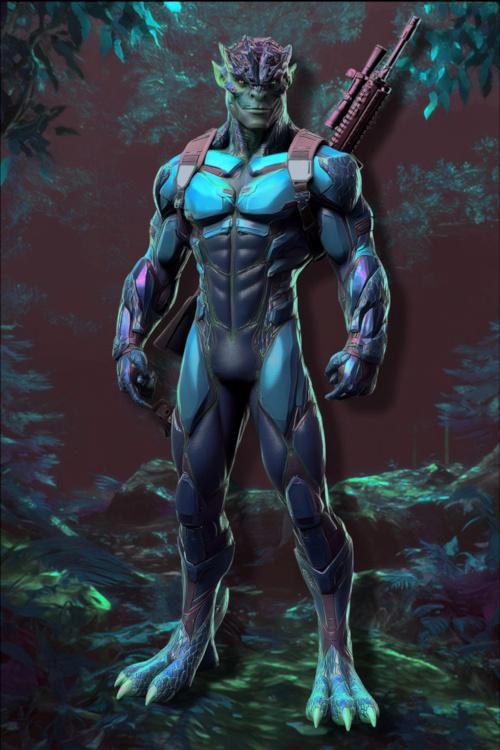
His head rested at an angle that would have been uncomfortable if he were fully aware, the ridged structure of it catching the overhead light in hard lines that made it impossible to mistake him for anything human. There was no hair, no softness to obscure the underlying shape, only smooth, scaled surfaces broken by subtle plating that shifted slightly as his body fought to maintain control. Even now, even injured, there was nothing fragile about him.

A heavy tail lay partly off the side of the cot, scaled like the rest of him and still except for the occasional faint twitch when pain moved through him. I had been careful not to step on it while treating him, though the absurdity of that thought had nearly broken through my concentration more than once.

Alien warrior bleeding out on my cot, and I was worried about where to put his tail.

I shifted closer and set the soaked cloth aside, reaching for a clean one from the tray. The basin beside me had long since gone cloudy, tinged pink from repeated use. I dipped the cloth, wrung it out, and went back to the wound, working carefully to clear away what I could.

It wasn’t clean damage.

The edges were wrong—too precise in some places, too irregular in others—and whatever had caused it had burned and torn at the same time, leaving tissue that resisted every instinct I had built through years of treating injuries that made sense. The structure beneath my hands was denser than it should have been, the muscle layered differently, the heat of him running higher than any human baseline I had ever recorded.

Not human. Even his scent was different.   It was a combination of mild-scented herbs and wet earth after rain—not unpleasant, just different.

That he was not human wasn’t a problem. It was just a fact I needed to work around. I had never treated his kind before.

The infirmary had been a school after the war and before my time. That war had changed everything into something else. Now this building held four cots in the old front classroom, a storage room I had turned into a supply closet, a second classroom we used when someone needed isolation or recovery, and a kitchen that still worked when the water lines cooperated. Behind it all was the narrow room I had claimed for myself, just large enough for a bed, a table, and the kind of privacy a settlement medic rarely got to use.

It served the entire settlement—small enough that I knew most of them by name, large enough that there was always someone needing something.

We were not equipped for this kind of trauma.

I exhaled slowly and reached for the coagulant, applying it with careful precision. His body reacted immediately, not with sound but with tension that moved through him all at once, a tightening beneath my hands that told me he was closer to awareness than I had assumed.

“Easy,” I said, lowering my voice without thinking.

For a moment, nothing changed. Then the tension eased—not fully, but enough that I could continue without fighting him.

I worked in silence, packing the wound and securing the bandage as best I could. It held. Not perfectly, but enough to give him a chance.

When I leaned back, I let out a breath I hadn’t realized I’d been holding and wiped my hands on a clean cloth, my mind already moving ahead to the next step.

He shouldn’t have made it this far. He hadn’t collapsed out in the settlement. He had reached the one place that might keep him alive—and then he’d stopped.

He hadn’t come through the central yard. Later, I would realize he must have followed the old drainage path behind the school, the one most people avoided because the ground dipped sharply and the brush grew thick against the rear wall. Injured or not, he had chosen the one route that kept him out of sight until he reached my door.

I could still see the way I’d found him when I closed my eyes—the heavy line of blood across the packed dirt outside the infirmary door, the way his body had been braced against the frame as if he had refused to fall until he had reached it. He hadn’t been fully conscious, but he hadn’t been gone either. When I’d told him to move, he had.

Barely.

Just enough that I could guide him.

Step by step, shifting his weight, forcing him to stay upright long enough to cross the threshold and reach the nearest cot before his body finally gave out under him. It hadn’t been strength that got him inside. It had been refusal—his and mine—to stop before it was accomplished.

I looked at him now, at the controlled stillness that had replaced that last effort, and wondered what had driven him to my door in the first place.

Then I stepped back to the cot and set my fingers lightly against his pulse.

It was strong.

Too strong.

The beat pressed against my fingertips with a force that didn’t match his condition, steady and insistent, as if his body were driving itself forward through will rather than stability. The texture beneath my touch was wrong in ways I was still adjusting to, the scaled surface holding heat differently, the structure beneath it less forgiving.

“That’s not right,” I murmured.

I leaned in slightly, concentrating on the rhythm beneath my fingers.

His hand moved.

Not fast enough to startle me into pulling away, but deliberate enough that I felt it before I fully registered it. His fingers closed around my wrist, the contact firm without being forceful, anchoring rather than restraining.

I stopped with my fingers still against his pulse.

His eyes remained closed, but the faint tightening along his jaw told me he was not as unaware as he looked. I watched his face, waiting to see whether he would surface or let me go.

The contact, however, changed something.

I felt it immediately.

My pulse shifted beneath his grip, the rhythm no longer entirely my own, heat spreading along my skin where he touched me in a way that had nothing to do with exertion or the warm air in the room. It wasn’t unpleasant. It wasn’t even painful, just unfamiliar.

I steadied my breathing before I answered him.

“Let go,” I said, keeping my voice even.

His fingers tightened slightly, though not enough to hurt. It was an answer, a silent refusal.

I exhaled softly through my nose, glancing briefly at his hand before returning my focus to the work in front of me.

“Fine,” I murmured. “We’ll do it this way.”

Instead of pulling free, I shifted my stance and continued the assessment with my other hand. Working around his grip as though it made no difference at all, I remained aware of the way my pulse had changed beneath his touch. The contact settled into my skin in a way I couldn’t ignore, not distracting enough to stop me, but present enough that I had to force my attention back where it belonged.

Little by little, the force of his heartbeat eased beneath my fingers until the relentless pressure became a rhythm I could believe his body might sustain.

It wasn’t just a consistent response—and that made it something I couldn’t ignore. I stilled, my concentration sharpening as I tracked the change. It was subtle but real.

My gaze shifted from his chest to his face, then briefly to where his hand circled my wrist before returning to study him more closely.

“Interesting,” I said under my breath.

I didn’t understand it yet. But I would. For now, he was alive, and I wasn’t letting him die.

Chapter Two 

Thexan

Consciousness did not return all at once. It surfaced gradually, sensation layering over darkness until there was no longer any separation between the two.

Pain anchored me first.

It spread along my side in a steady, controlled burn, not sharp enough to disrupt awareness but persistent enough that I could not ignore it. The damage was deeper than the initial impact had suggested. My body was attempting repair, but the response was inefficient, the process slowed by disruption along my neural pathways.

I remained still long enough to let my senses recalibrate. Instinct urged me to rise, assess, eliminate. I refused it. Moving before I understood my condition would worsen the damage, and I had survived too much to make that error now.

The air was wrong.

Enclosed. Contained. Carrying the sterile traces of human habitation layered over older materials and worn structure. Not open terrain. Not a battlefield. Not any environment I had occupied in recent memory.

Human.

The recognition sharpened my focus.

I drew in a measured breath, filtering what I could through the residual distortion in my senses, and that was when I became aware of her.

Close.

Closer than any human should have been.

The response to her struck me immediately, bypassing conscious thought and striking at a level I had not felt since before the war had altered everything I understood about my own nature.

Protect.

The instinct aligned with something deeper, something embedded beyond discipline or conditioning.

My body answered her before thought could intervene. The impulse drove through me with a force unrelated to the wound, old and absolute. I held myself motionless until I could bring my attention back to her rather than the instinct demanding action.

Tension gathered along my muscles despite the injury that should have limited me, my awareness narrowing with a precision that left no room for distraction.

Her.

I opened my eyes.

Light resolved first, then the boundaries of the room. A quick assessment found no immediate threat. Only then did I turn my head, ignoring the pull of the wound, until I could see her clearly.

She was human.

There was no mistaking it at this distance, no confusion in the details my vision provided. Smaller in structure, unarmored, her skin smooth where mine was scaled, her movements precise but lacking the reinforcement my kind carried as a matter of design.

And yet none of that mattered.

The recognition struck fully this time, no longer restrained by incomplete awareness or distance.

She was mine.

The certainty arrived whole, leaving no space for argument.

Every muscle in me locked.

No.

No. Discipline answered as quickly as instinct had. My neural damage had weakened more than my body; it had stripped away some of the fine restraint I normally placed between impulse and action.

To acknowledge the bond in this condition, to allow it to influence my actions, would place her at risk.

That was not acceptable.

I forced the reaction down, containing it as best I could while I assessed her more closely. She was focused on the injury at my side, her attention fixed on the damage rather than the threat I presented. Her hands moved with measured confidence, applying pressure, and adjusting the treatment without hesitation.

She did not fear me, though she should have. That did not reassure me. It made her proximity more dangerous, because every instinct I possessed had begun to treat her nearness as necessary.

Distance was necessary. From her, from the bond that had already begun to assert itself, from the instability within my own system that I could not fully regulate. I understood that clearly enough, yet the response that followed did not come from a conscious decision. My hand moved before I could stop it, my fingers closing around her wrist with a precision that had nothing to do with intent and everything to do with need.

Her palm touched the center of my chest, and the disorder inside me changed at once.

The noise along my neural pathways drew inward toward that single point of contact. Pain remained, but clarity returned around it, enough that I could think without fighting my own body for every thought.

“You should not be here,” I said, my voice rough from disuse, the words slower than they should have been but controlled.

She did not retreat.

Her gaze remained on me, steady, assessing, as though she were evaluating the statement rather than reacting to it.

“With you?” she asked.

I met her eyes.

“Yes.”

The answer required no hesitation.

I expected her to move away. Any rational assessment of the situation would have led to that conclusion. Instead, she stepped closer, closing the distance I had just established as though my warning held no weight at all.

Before I could prevent it, her hand came to rest against my chest.

The contact was direct, unguarded, her palm pressing lightly against the center of my sternum.

Whatever restraint I had rebuilt gave way.

This time the change ran deeper. The tension in my body loosened despite the wound, and breath came without effort for the first time since I woke.

I drew in a breath.

It came easily.

More easily than it had since I regained awareness.

For several heartbeats, all I could comprehend was the impossible fact of her trust. She had stepped closer when every rational response should have sent her away, and something in me answered to that choice with a need that had nothing to do with injury.

Something moved through me that did not belong to pain, injury, or neural disruption.

It was need, sharpened by the knowledge that she had placed herself within reach of a male she should have feared and had done it because she chose to understand instead.

I looked from her hand on my chest to her face. What she was to me no longer felt like a conclusion I had reached; it felt like a fact my body had recognized before my mind was willing to name it.

She was not only stabilizing me.

She was becoming the point around which every other calculation altered.

That realization should have brought clarity.

Instead, it produced something dangerously close to fear.

Not for myself.

For her.

This changed everything.

And in my current state, I did not yet know whether that would ensure her survival—

Or guarantee her destruction.

Chapter Three

Brynn

His warning should have made me move away.

For one heartbeat, I almost did.

Every sensible instinct I had told me to put distance between us, to listen when a wounded alien warrior looked me in the eyes and told me I was in danger. But my hand was still against his chest, and beneath my palm, his breathing had changed. The tension that had been locking his body in place had eased. His pulse no longer felt like it was trying to tear through him.

Whatever was happening, my touch was helping.

And he hadn’t warned me like a man making a threat.

He had warned me like a man fighting himself.

So I stayed.

I kept my hand against the center of his chest, feeling the strange, structured heat of him beneath my palm while I watched his face for any change that might tell me whether I had made the wrong decision. There were ridges along his brow and cheekbones, subtle but unmistakable, catching the infirmary light in a way no human bone structure ever would. His skin was not skin the way mine was. Up close, it had a scaled texture, smooth in some places, faintly plated in others, with a density beneath it that made my hand feel too human, too soft, too breakable by comparison.

And yet he was the one lying on my cot, bleeding through a bandage I had already changed twice.

“You said I was in danger from you,” I said, keeping my voice even because his body had gone dangerously still beneath my touch. “Are you warning me because you intend to hurt me, or because you’re afraid you might?”

His eyes remained on mine. They were not human either. I had known that before, but awareness and direct confrontation were two different things. In the dim light they looked almost golden, though that didn’t fully describe them. There was too much depth, too much contained intensity, as if some inner heat still burned behind the exhaustion and pain.

“I do not intend harm,” he said.

The words came rough, shaped with effort, but his meaning was clear enough.

“Then we’ll start there.”

His chest moved under my palm as he drew in a slow breath. I felt the movement before I heard it, the controlled expansion of a body built with more strength than anything I had treated before. The tremor that followed was slight, almost hidden, but I caught it anyway because I had been watching him too closely not to.

“You should remove your hand.”

“I probably should,” I agreed.

I didn’t.

His fingers loosened from my wrist by slow degrees, not because he wanted to let go, but because he had decided to. The release should have made the contact between us less intense.

It didn’t.

If anything, my palm against his chest felt more deliberate now that he was no longer holding me there.

The corner of his mouth tightened, not quite in pain and not quite in impatience. “Human female—”

“Brynn,” I interrupted.

He stared at me as if I had given him something he did not know what to do with.

“My name is Brynn Ellison. If you’re going to keep warning me that I’m in danger while lying half-conscious in my infirmary, you can at least use my name.”

I thought he might refuse. Instead, his attention fixed more sharply on me.

“Thexan.”

The sound of it moved through the room differently than a human name would have. Low. Precise. Foreign enough that I knew I would remember it.

“Thexan,” I repeated, testing the shape of it carefully.

Something changed in him when I said it. Not visibly, not enough that anyone else might have noticed, but I was close enough to feel the response beneath my hand. His breathing deepened by a fraction, and the hard tension through his chest eased before he seemed to realize it had happened.

I looked down at my hand, then back at him.

“That helps too.”

His eyes narrowed. “What helps?”

“Contact.” I shifted my palm slightly, not pressing harder, only adjusting to feel the rhythm beneath it. “Your pulse was too strong before. Too forceful. Not fast exactly, but wrong. When you grabbed my wrist, it started to settle. When I touched your chest, your breathing improved.”

“That does not mean you should continue.”

“No, but it does mean I need to understand why.”

“You do not.”

That was almost enough to make me smile, though I was too tired and too concerned to let it reach my face. “You don’t know me well enough to tell me what I need to understand.”

“I know enough.”

“You know I’m human. That’s not the same thing.”

His gaze moved over me then, more assessing than before, and I had the unsettling sense that he was cataloging me with the same precision I had been trying to apply to him. I should have been uncomfortable under that scrutiny. Maybe I was, but not in a way that made me want to retreat. The awareness of him was too strong, filling the small infirmary until the familiar room no longer felt quite like mine.

I removed my hand from his chest.

The reaction was immediate.

His body tightened, and though he controlled the response quickly, I saw enough. More importantly, I felt the change in the air between us, as if a thread had pulled taut the instant contact broke.

I set my fingers against his wrist instead, because I wanted to know whether the effect depended on location or simply on touch.

His breath left him slowly.

“All right,” I murmured. “Not just the chest.”

“Brynn.”

My name in his voice should not have affected me the way it did. It was too rough, too strained, shaped by an alien mouth and a body still fighting shock, but the sound settled under my skin all the same.

I forced my attention back to his pulse.

“You’re improving when I touch you,” I said. “You deteriorate when I don’t. I don’t have to know why yet to recognize the pattern.”

“You should not rely on a pattern you do not understand.”

“I agree. That’s why I’m still collecting information.”

His fingers flexed once beneath mine, but he did not pull away. “You are not afraid enough.”

“I’m exhausted,” I said honestly. “Sometimes that looks the same.”

For the first time, something almost like confusion crossed his face.

I let out a breath and reached for the diagnostic tablet on the tray beside the cot. Most of its functions were unreliable when used on anyone outside the human baseline, but it could still record temperature, pulse pressure, respiratory shifts, and electrical irregularities if I adjusted the settings manually. I had repaired it twice with scavenged parts and sheer refusal to let another useful thing die. It flickered when I activated it, then steadied.

“Try not to move.”

“I am injured, not undisciplined.”

“That remains to be seen.”

His gaze fixed on me again, and this time the silence carried something different, a faint undercurrent that might have been irritation if he had been human. I found that oddly reassuring. A patient annoyed with me was usually less likely to die in the next five minutes.

I ran the scan slowly, adjusting the angle when the diagnostic tablet protested the density of his body. The readings came back uneven, some useless, some fascinating. Elevated temperature. Irregular neural activity. Cardiovascular force far beyond human tolerance. Tissue damage along the wound site complicated by an energy residue I could not identify.

“What did this?” I asked.

His expression closed.

That was answer enough.

“Thexan.”

The name worked again. His attention returned to me, immediate and intense.

“I need to know if whatever hurt you is going to kill you while I’m standing here guessing.”

“The weapon was designed to disrupt repair response.”

I looked down at the wound. “That explains why it keeps reopening.”

“It also disrupts neural regulation.”

My gaze lifted. “That explains the instability.”

“Yes.”

“And the contact?”

He looked away.

Not far. Only enough that he was no longer meeting my eyes.

That, more than anything, made my hand still over the diagnostic tablet. I didn’t like not understanding something this fundamental—especially when it involved my own body as much as his.

“You know what this is.”

He did not answer immediately. The quiet stretched between us, filled with the low hum of the overhead light and the distant sound of someone laughing outside the infirmary, oblivious to the fact that I had an injured Mesaarkan warrior on my cot and no idea whether I had just saved my settlement or invited danger into the center of it.

“I know enough,” he said at last.

“That’s becoming a very annoying answer.”

“It is the only one I can give you safely.”

I set the tablet down with more care than I felt. “Then give me the unsafe one.”

His eyes returned to mine.

The room seemed to narrow again.

The room narrowed to details: blood beneath my nails, the ache between my shoulders, the heat of his wrist under my fingers, the shallow rise of his bandaged chest, and the impossible steadiness of his eyes on mine.

Then he said, “My body recognizes you.”

The words should have been meaningless without context. They weren’t. I didn’t understand them, but some part of me reacted before thought could intervene, a small tightening low in my body, a warmth that had nothing to do with the infirmary or exhaustion.

I made myself breathe normally.

“As what?”

His answer came slowly, as if each word required discipline.

“As necessary.”

The answer gave me a category without giving me meaning.

I looked down at the place where my fingers still rested against his wrist. His pulse had steadied further, the earlier force easing into a rhythm that no longer felt as if his body were trying to tear itself apart from the inside.

“And that makes me dangerous to you?” I asked.

“No.”

“To myself?”

His jaw tightened. “Potentially.”

I stared at him.

That was it.

That was the point where whatever patience I had left thinned past usefulness. He was bleeding on my cot, responding to my touch in ways neither of us could ignore, warning me in fragments, and now apparently there were enemies somewhere beyond my door who might be moving toward a settlement full of people who had no idea danger was coming.

I pulled in a breath and let it out slowly.

“Thexan,” I said, keeping my voice level by force, “what the hell is going on?”

His attention snapped fully to me.

“I need more than yes, no, and potentially,” I continued. “I need to know what this is, what you are, and whether everyone outside this room is in danger because you came here.”

He let the question hang between us before answering.

Then the surrounding air seemed to harden.

“Yes,” he said. “They are in danger.”

The answer landed cold.

“Who is they?”

“The ones tracking me.”

“How close?”

“I do not know.”

“How many?”

“I do not know that either.”

“But they’re dangerous.”

“Yes.” His eyes held mine, and this time he did not leave the answer there. “They are trained to remove threats without hesitation. If they find me here, they will not spare this structure because it contains civilians. They will not spare you because you lack information. They will evaluate proximity, interference, and usefulness. If you have aided me, you become a variable. Variables are removed.”

I closed my eyes briefly, because my mind needed one quiet second to rearrange the shape of the problem.

An unknown number of dangerous Mesaarkans—or something close enough to them to wound him—might be tracking him toward a settlement full of exhausted people with patched walls, aging weapons, and more courage than training.

When I opened my eyes, he was watching me.

“You should alert your leaders,” he said. “They should evacuate this structure and move your people away from me.”

“That would expose you.”

“Yes.”

“And if your enemies find you before you can stand?”

His expression did not change, but the stillness in him shifted into something colder.

“Then the threat remains concentrated on me.”

I stared at him. “You mean you die before they reach anyone else.”

“If I cannot move, that is the most efficient outcome.”

“No.”

His eyes hardened. “You do not understand.”

“I understand enough to know that men who say things like that are usually trying to make dying sound practical.”

“It is practical,” he said, rougher now. “It is not preferred.”

That stopped me.

For the first time, I heard something beneath the calculation. Not fear exactly. Not for himself. Something tighter than that.

“You don’t want to die,” I said.

“No.”

The answer was immediate this time.

“And yet you’re telling me to let it happen.”

“I am telling you to protect your people.”

“It’s also inconvenient,” I said, because if I let the moment get any heavier, I might feel it too much. “Since I just spent a great deal of effort keeping you alive.”

That should not have mattered to him.

I saw that it did.

Not much. Not in any way he would willingly show. But something in his face shifted, a minute change around the eyes, a softening so brief I might have imagined it if I had not been watching him with the focus of a woman trying to keep him from bleeding out on her cot.

I drew another breath and made the decision before I could talk myself out of it.

“You’re staying here tonight.”

“No.”

“Yes.”

“Brynn—”

“You cannot stand without tearing that wound open. Your neural regulation is unstable. Your body responds positively to proximity, which means sending you away would be medically stupid even if it were morally convenient. I’m not doing it.”

“You place yourself at risk.”

“I place myself at risk every time someone drags a half-dead stranger to my door.”

“I am not a stranger to your kind.”

“No,” I said, glancing over the scaled structure of his chest and the ridged planes of his face. “You definitely are not.”

His mouth tightened again, and this time I was almost certain it would have been a grim smile on anyone else.

I stepped away only long enough to retrieve a clean blanket from the storage cabinet. The moment distance opened between us, I heard his breathing change. He controlled it quickly, but not quickly enough. I turned back and found him staring at the ceiling, every line of his body held in rigid restraint.

“You feel that when I move away.”

“Yes.”

The honesty surprised me.

I returned to the cot and spread the blanket carefully over him, avoiding the wound. “Does it hurt?”

“Not physically.”

That answer stayed with me.

I should have asked more. I should have demanded a full explanation, one that included every risk he had not yet named. Instead, I found myself studying the controlled tension in his face and the way his fingers had curled against the blanket, not reaching for me, not asking, but fighting the need to do both.

For reasons I did not want to examine too closely, that mattered.

I sat in the chair beside the cot and rested my hand lightly against his forearm.

His eyes closed.

The effect was quiet this time, but no less real. The tension eased from him gradually, not disappearing but settling into something his body could bear. I watched the change with the same clinical attention I had given the wound, though there was nothing clinical about the way my own pulse responded.

“This is temporary,” I said, though I wasn’t sure whether I meant the treatment, his presence in my infirmary, or the strange connection tightening between us.

His eyes opened again.

“No,” he said softly. “It is not.”

I held his gaze, and for the first time since I had found him at the ridge, I let myself consider the possibility that the danger he represented was not the only reason I couldn’t make myself step away.

Then someone knocked hard on the infirmary door.

I stood too quickly, and his hand caught mine before I had taken a full step. This time, there was no unconsciousness to excuse it. His fingers closed around mine with controlled urgency, and his voice dropped lower than before.

“Do not open it until you know who stands outside.”

I looked toward the door, then back at him.

The knock came again.

“Brynn?” Tanner called from the other side. “You in there? We found blood on the lower ridge.”

Thexan’s grip tightened around my hand.

Not painfully.

Protectively.

And every instinct I had told me that whatever had followed him into my mountains had already begun to arrive.

End of sample.
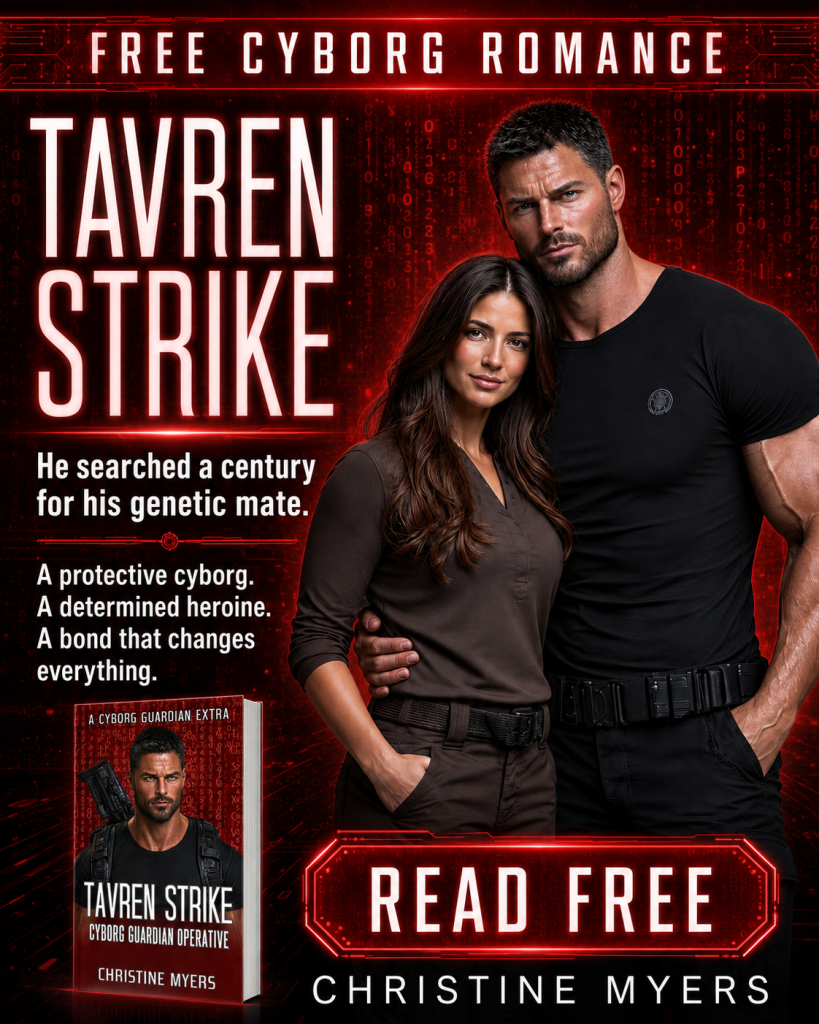
Claim Your Free Cyborg Guardian Romance Today

Meet Tavern Strike

He searched a century for her.

Now nothing will take her from him.

I’m excited to introduce Tavren Strike: Cyborg Guardian Operative, a brand-new story in my Cyborg Universe, free as a subscriber gift.

Tavern Strike

Tavren is a Cyborg Network field operative who has spent years traveling through isolated settlements, tracking raiders, investigating missing communities, and helping people who have little protection of their own.

But that isn’t the only reason he keeps moving.

Since his awakening eleven years ago, Tavren has also been searching for the one woman his systems were designed to recognize—his genetic mate.

He finally finds her at the gate of a struggling agricultural settlement.

Her name is Nola Brent.

And she is not waiting around for a cyborg to take charge of her life.

Nola Brent

Nola has spent years keeping forty people alive. She repairs failing equipment, organizes food and water, settles arguments, and makes the decisions no one else wants to make. She has learned not to depend on anyone more than necessary.

Then Tavren arrives.

He is powerful enough to defend her settlement.

Skilled enough to repair the systems that are beginning to fail.

And absolutely certain that Nola is the woman he has searched for his entire existence.

There is only one problem.

Nola intends to make her own decisions.

Fortunately, Tavren has no interest in taking her authority away from her. He doesn’t want to replace her.

He wants to stand beside her.

And when a raider named Carden Rusk threatens to seize the settlement, Tavren and Nola have to learn very quickly whether trust can become partnership—and whether genetic recognition can grow into something much deeper.

Tavren Strike has many of the things I love writing into my Cyborg Universe stories:

protective cyborg hero, fated/genetic mates, a capable heroine, found family, a threatened settlement, action and danger, and a hero who has spent far too long waiting for the woman who finally gives him a home.

And yes, there is romance.

Quite a bit of it.

Read Tavren Strike Free

Tavren Strike: Cyborg Guardian Operative is available free to my readers.

Click on the button below to read TAVREN STRIKE free!

If you already enjoy the Cyborg Guardians, Tavren gives you another look at the world beyond the established Guardian territories.

And if you’ve never read one of my cyborg romances before, this is a great place to meet them.

Tavren may have been created for war.

But Nola gives him something much more important to fight for.

A future. A family. And a place to come home to.

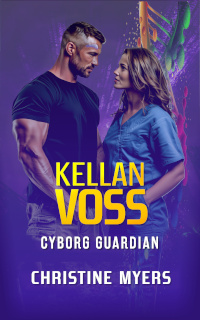
Kellan Voss Cyborg Guardian

Sample Chapters

Cyborg Guardian Book Four

Chapter One

Sunfall Station

Kellan Voss

Los Angeles should have been dead by now, the Mesaarkans having done enough damage to ensure that nothing this complex could still be functioning decades after the initial attack.

From the ridge above the basin, the city stretched out below me in fractured layers of collapsed structures and fused metal. The remnants of towers and transit lines formed a landscape that hadn’t recovered so much as hardened into something that endured. The ocean sat as a dull gray band in the distance beneath. It had finally cleared after a century. Nothing about what remained suggested long-term stability at this scale.

Yet I registered it immediately. It was coming from an old underground transit system hub, one of many places adapted by survivors, and descendants in various cities around what was once the United States of America.

The power moving through the ground beneath my boots was steady, controlled, and far too consistent to belong to scavenged systems or temporary fixes. The signal carried a level of precision that indicated maintenance rather than survival. It didn’t fluctuate or degrade under load, and that alone made it incompatible with anything that should still be operational this long after the war.

That alone was enough to shift it from anomaly to threat, the kind of controlled output that didn’t exist without intent behind it.

“Say that again,” I murmured.

The comm at the base of my skull warmed as the signal stabilized, and Max Steele’s voice came through, steady as always but carrying the kind of focus that meant he had already evaluated multiple failure scenarios.

“Sunfall Station is producing more output than anything west of Denver,” he said. “And it’s been doing it for six months without command authorization.”

Six months was not an anomaly. It was control.

My gaze tracked the broken transit lines feeding into the center of the basin, where the station had been buried beneath what used to be a metro hub, the collapsed structures above it reinforced and repurposed into something that no longer resembled its original design. Improvised antennae extended upward through the wreckage, angled to catch sunlight and direct it downward.

Movement registered along the lower levels—organized, deliberate, following patterns rather than reacting to them.

That told me more than the power output.

“Are you sending a team?” I asked.

“No.”

The weight behind that answer was immediate.

“I’m sending you.”

I adjusted my stance and expanded the scan radius, letting my systems pull in deeper readings from below as Mesaarkan, human, and hybridized signatures overlapped in ways that resisted clean classification. Nothing about the distribution suggested instability, which made it more concerning, not less.

That level of integration required control.

“Guardian jurisdiction?” I asked.

“Officially, recon and assessment,” Max said. “Unofficially, if Command hits this place blind, we risk waking something we can’t shut down.”

That aligned with what I was seeing.

I crouched near the fractured railing at the edge of the ridge and pressed my fingers briefly against the metal, feeling the faint vibration before my systems translated it into frequency, pattern, and harmonic consistency. The structure held a precision that ruled out improvisation. This had been designed.

Someone had built this to function.

“And who’s running it?” I asked.

There was a brief pause—subtle, but deliberate enough to register.

“Tamsin Ward,” Max said. “CRENA-trained systems engineer. Went off-grid five years ago.”

Five years ago, I had returned to Earth after the war because my genetic match had finally been identified. By the time I arrived, Tamsin Ward had already gone off-grid, leaving the Enclave with a name, a genetic confirmation, and no location. I had spent years knowing she existed somewhere on Earth, but not where to find her.

The name didn’t pass through my system as simple data.

It landed deeper than that, triggering an immediate internal response that bypassed standard processing, my systems reacting before I consciously interpreted why. Compatibility metrics initiated automatically, genetic data cross-referenced without prompting, but I didn’t need the results to understand what was happening.

I felt it.

The shift was physical and immediate, my pulse increasing before I regulated it, neural activity spiking outside normal threat or environmental parameters as something in my system aligned to her presence without requiring confirmation.

There was nothing gradual or uncertain about it. The realization settled into place fully formed—she was my genetic match.

It wasn’t a conclusion I reached through analysis or deduction, but something my system accepted as fact the moment her identity registered, the response too precise to misinterpret and too immediate to dismiss.

I went still on the ridge, my attention fixed on the basin below, aware that I couldn’t isolate her exact position through layers of collapsed infrastructure and shielding.

That didn’t matter. The alignment had already occurred.

“You didn’t mention she was here,” I said, keeping my tone controlled.

Max didn’t respond immediately.

“I knew what that would do to your focus,” he said. “You needed to assess the situation before the bond had a chance to complicate it.”

He didn’t want me distracted. It was far more than just a distraction. Disruption was closer to reality.

“And the match?” I asked.

“Confirmed.”

No hesitation.

Of course it was. I could feel it.

“You should have told me.”

“I made a call,” he said. “You’re the best one to handle this. I wasn’t going to compromise that before you even set foot in the station.”

That was a calculated decision, and not an unreasonable one.

“There’s no scenario where this bond doesn’t activate,” I said.

“It already has,” Max replied.

He was correct. The response I was experiencing wasn’t anticipation. It was onset.

“Then it won’t interfere,” I said, intending that to be true.

There was a brief silence before Max spoke again.

“See that it doesn’t,” he said. “Because if that core destabilizes, we’ve got more than one problem.”

“Understood.”

“I’ll be listening.”

The channel closed.

I remained on the ridge a moment longer than necessary, not because I needed additional data or confirmation, but because the signal below was no longer the only variable drawing my attention.

She was.

And I hadn’t seen her yet.

The descent into the basin should have required full focus.

It didn’t.

I paused at the edge of the descent long enough to check my gear one more time, more from discipline than necessity. The nanite armor was already engaged, sealed over my body in a dark second skin calibrated for impact, heat, shrapnel, and energy feedback. I had not brought spare clothing because I didn’t need it in the field. The armor could recede when necessary and reform at a thought, which made conventional combat gear redundant.

That didn’t mean I entered an unknown station unequipped.

My utility belt carried field clamps, med patches, emergency nanite boluses, scanner chips, compact tools, and emergency power cells. A sidearm rested in the holster at my hip, and my rifle was secured across my back by a magnetic sling, close enough to draw if the approach turned hostile but out of the way while I moved through broken terrain.

Nothing about the gear was ornamental. It was what a Guardian carried when walking into a place that should not have been alive.

The deeper I moved through the ruins, the more pronounced the awareness became, the steady hum of power beneath my feet intensifying while something else settled alongside it—something internal, integrating into my system without registering as interference.

It didn’t spike or fluctuate. It aligned with a steadiness that made it far more difficult to dismiss, integrating into my system without resistance as if it had always belonged there.

I had operated for decades without anything compromising my focus, every response controlled, every reaction measured and contained within mission parameters.

This wasn’t compromise. It was integration,

and that made it far more difficult to ignore.

The entrance to Sunfall lacked the defensive structure I expected. There were no visible choke points and no automated weapon systems designed to control approach vectors. Just people.

Armed, alert, and steady in a way that suggested experience rather than reliance on infrastructure.

They stopped me, questioned me, and assessed threat level and intent.

I answered, maintaining the tone that prevented escalation, but even as I did, part of my attention remained directed forward, pulled deeper into the structure of the station toward something I could not yet see but no longer needed to locate through conventional means.

The closer I moved, the clearer it became that this wasn’t just recognition. It was connection.

  The corridor opened into a larger chamber, and the moment I crossed the threshold, my awareness of her sharpened. The bond settled more firmly into place as my system responded to proximity.

Before I saw her, I understood the situation.

The system itself confirmed the precision of the power flow and the efficiency of the routing, indicating control beyond what should have been possible under these conditions.

Then I saw her.

My reaction was immediate and far more intense than I had anticipated, my pulse increasing again before I could regulate it as my attention locked onto her, my system responding to her presence in a way that made it difficult to shift my focus anywhere else. It wasn’t just visual recognition or confirmation of identity—it was a full-system response, my heart rate increasing again as the connection integrated more completely, reinforcing what I had already recognized on the ridge.

She stood at the center of the chamber with one hand braced against a console emitting a steady, controlled glow, her other hand moving through a projected interface with practiced precision. There was no hesitation in her movements, no sign that she was reacting to instability.

She was controlling and maintaining it.

My system tracked every detail automatically, but my attention remained fixed on her, returning to her even when I attempted to broaden my focus to include the rest of the environment.

Someone spoke her name.

“Tamsin Ward.”

When she turned, the reaction hit immediately. My attention locked onto her in a way that made everything else in the chamber lose priority without conscious input. Visual recognition and confirmation of identity became a full-system response, further increasing my heart rate as the bond settled more firmly into place, reinforcing what I had already recognized before I ever saw her.

Her breath caught—subtly, controlled, but present—and the fact that I registered it at all told me everything I needed to know.

She felt it too.

There was no confusion in her expression, no hesitation or attempt to dismiss what had just happened. Her awareness was immediate and matched my own, removing any remaining uncertainty about what this was.

The moment our eyes met, our connection solidified completely. Our bond settled into place with a level of certainty that left no room for reinterpretation. My system registered alignment as it locked.

That was enough.

The realization settled into place fully formed—she was my genetic match.   My certainty of it didn’t come from analysis but from the way my system had already aligned to hers without hesitation. It wasn’t simply a biological phenomenon. It came with an empathic connection that we called the bond. In some cases, it became telepathic.

Standing there in front of her, already aware of the way my system had aligned to hers, I understood that maintaining operational control was no longer just a matter of discipline.

It was a matter of timing. Until now, I knew I had a match out in the universe somewhere. I even knew her name, but I didn’t know where to find her when the time was right. Now here she was, and she was beautiful.

I wanted her the moment I saw her. For a time, that overwhelmed my purpose for coming here. It took more seconds than usual to pull my systems under control. This was going to be even harder than I anticipated.

Chapter Two   

First Contact

Tamsin

The system had been stable for three hours, not perfectly stable. Nothing running on a hybrid Mesaarkan matrix ever was. But it was stable enough that I could step away from the core without expecting it to spike the moment my attention shifted elsewhere. The containment algorithms were holding, harmonic variance inside acceptable thresholds, and the deeper logic net—what little of it I allowed to remain active—had gone quiet.

That was as close to peace as Sunfall ever got.

I rested my hand against the console, feeling the low vibration of the core through the reinforced surface, letting the rhythm settle into something familiar as I tracked the secondary readouts. Power routing, structural load, thermal distribution—everything moving the way I had designed it to move, everything balanced on the edge of failure in a way that required constant control to maintain.

That didn’t bother me. Balance had never come from safety. It came from control.

“Tamsin.”

I didn’t look up right away. Darek, our defense chief, rarely interrupted unless it mattered. The fact that he used my name instead of waiting meant he had already decided this wasn’t something I would want delayed.

“Tell me it’s not the lower grid,” I said, watching the flow stabilize across the secondary conduits.

“It’s not the grid.”

That pulled my attention immediately.

I glanced over, reading the set of his shoulders before I fully turned. Not alarmed. Not urgent.

Measured.

“Then what is it?”

“We’ve got a visitor.”

That alone wasn’t unusual. Traders, scouts, and small groups looking to barter for power access or safe passage came through often enough. Most of them decided quickly they didn’t want to deal with us.

“That doesn’t explain why you’re interrupting me,” I said.

“He gave a name.”

Something in his tone shifted just enough to pull my focus completely away from the system.

“What name?”

“Kellan Voss.”

The reaction hit before I could stop it.

It moved through me fast and deep, sharper than anything I had felt since the first time I interfaced with the Mesaarkan core and realized just how unstable it really was. My breath caught, a brief, involuntary break in control that I hadn’t experienced in years, my body responding before my mind could reassert discipline.

Kellan Voss. The name didn’t land as information. It settled into place as recognition because he was the cyborg genetic mate I hoped would find me one day.

I turned fully now, the system falling into the background in a way it never did unless something else demanded more of my attention. The steady awareness I had learned to ignore over the past weeks suddenly sharpened into something focused and undeniable.

“He’s here?”

“Yes.”

“How far inside?”

“Lower concourse. We’ve got him stopped.”

That was procedure.

It wasn’t enough.

The pull I had been managing—subtle, intermittent, easy to dismiss as system interference or fatigue—wasn’t subtle anymore. It had direction now, a clear line that stretched from where I stood to him somewhere below, tightening with every second I remained still.

“Bring him in,” I said.

Darek hesitated.

“That’s it?” he asked. “No delay? No screening?”

“If he made it past the outer perimeter without incident, he’s already been screened,” I said. “And if he is who he says he is, we don’t leave him standing in a corridor.”

“That’s not what I’m asking.”

I met his gaze.

“I know.”

Darek studied me for a moment, and I knew what he was seeing.  My focus had shifted from the system to something else that had taken priority without my permission.

“You knew this was coming,” he said.

“I knew it was possible.”

His gaze sharpened. “Possible how?”

I held his eyes, because if there was anyone in Sunfall who deserved the truth before rumors filled in the gaps, it was Darek.

“Kellan Voss is my genetic match.”

Darek went still. He was not exactly shocked.

But the weight of it landed the way it should have.

“Confirmed?”

“Enough that I felt it when you said his name.”

His attention flicked once toward the corridor, then back to me. “Does he know?”

“If he’s close enough to feel the bond, he knows.”

Darek absorbed that in silence, his expression tightening with the practical concerns I expected from him. Security. Command. The system. Me.

“That changes things,” he said.

“Yes.”

“Does it compromise you?”

“No,” I said, and meant it. “But pretending it doesn’t matter would.”

That answer seemed to settle him more than denial would have.

He nodded once. “Then I’ll bring him in.”

“Darek.”

He paused.

“This stays with you for now.”

“Understood.”

I had prepared for the possibility when I submitted my DNA. I decided that if I was going to build something that lasted in a place like this, I wouldn’t do it alone.

Preparation wasn’t the same as reality.

It wasn’t the same as feeling the bond—our bond—settle into place with a certainty that didn’t leave room for hesitation the moment his name reached me.

“Bring him in,” I said again, quieter now, but no less certain.

Darek nodded and turned away.

I remained where I was for a moment longer, my hand still resting against the console. Forcing my attention back into the system, I felt the steady pulse of the core under my palm, tracking the familiar rhythm as if it should anchor me the way it always had.

It didn’t.

The system itself hadn’t changed, but my awareness of it had shifted in a way I couldn’t ignore. The focus I normally held on every fluctuation and variance slipped just enough that I had to consciously pull it back into place. It wasn’t gone, not even close, but it no longer held the same central weight in my attention, as if something else had moved into that space without asking permission.

That had never happened before.

I exhaled slowly and pushed away from the console, straightening as I turned toward the chamber entrance, already aware of the pull intensifying as I moved. It wasn’t overwhelming or disorienting, but it was a constant, steady pressure that didn’t fade no matter how I adjusted my focus. This was something I had to account for instead of dismiss.

I had read the reports, studied the data, and understood the biological and neurological responses tied to genetic compatibility and cyborg bonding well enough to predict the general pattern.

None of that translated to this.

This didn’t feel like something activating.

It felt like something settling into place.

Footsteps sounded in the corridor beyond the chamber, measured and controlled, and the moment they registered, the pull sharpened, narrowing into something precise enough that I no longer needed to question what I was feeling or where it was leading.

I felt him before I saw him.

The exact moment he crossed the threshold, the bond tightened with a clarity that shifted everything else in the room out of focus. My attention locked forward without conscious input as if my system had already made the decision for me.

Then he stepped into view.

For a fraction of a second, my breath stalled—not because of what he was, but because of the way my body reacted to his presence. The moment I saw him, my response was immediate and far more intense than anything I had prepared myself for.

Cyborg. Guardian. Built for war, for control, for survival.

I understood all of that.

None of it mattered.

What held my attention was the way he moved, the quiet certainty in it, the way his presence filled the space without force or display, as if he didn’t need to prove anything to anyone around him. And when his focus shifted and locked onto me, the precision of it matched exactly what I felt pulling in the other direction, the connection aligning immediately.

That was what made it real—not the data I had reviewed or the decision I had made when I submitted my DNA. The way the recognition settled into place the moment I saw him was complete and undeniable. My mind and body responded as if it had already accepted him long before this meeting ever happened.

It was like an epiphany. Here he was, and suddenly I knew Kellan Voss was the man meant to share the rest of my life with me. There was nothing gradual we needed to confirm or work through. I had chosen to accept our match before this moment existed. The bond was aligning exactly the way the reports said it would. All that remained was to accept the reality of that choice taking form in front of me.

Someone at the edge of the room said my name, but it barely registered against the shift already happening.

“Tamsin Ward.”

I turned fully, though my attention had never left him, and when our eyes met, the bond tightened further. I felt our connection with a depth that made my pulse jump despite every instinct I had to keep control.

His appearance registered in pieces—height, build, the way his body armor fit him like a second skin—but none of that held my focus for long.

It was him.

The way my body responded to him.

The way the pull didn’t ease once I acknowledged it but settled deeper, more defined.

I stepped toward him without making the decision consciously, closing the distance because it already felt unnecessary.

“Kellan Voss.”

Not a question.

“Yes.”

His voice was steady, grounded in a way that cut through the rest of the noise in my head more effectively than anything else had.

“I’m Tamsin Ward,” I said, my voice more controlled than I felt. “I expected you sooner.”

The corner of his mouth shifted slightly, not quite a smile.

“I came as soon as I was sent.”

I held his gaze for a moment longer, letting the reality of this settle without trying to contain it, then added, more evenly, “I’m glad you’re here.”

It wasn’t everything I could have said.

But it was true.

The bond held steady between us, constant and impossible to ignore, no longer something I could push to the edges of my awareness without effort.

He stepped closer, closing the last of the distance with quiet certainty, and took my hands in his.

The contact was immediate—warm, steady, deliberate.  My pulse caught again before stabilizing as my body adjusted, recalibrating around the connection instead of reacting against it.

He watched me for a moment, confirming something he already understood.

“You felt it,” I said.

“Yes.”

His grip didn’t change.

“So did I.”

There was no point pretending otherwise—no point trying to frame it as anything less than what it was.

This wasn’t something that could be managed by ignoring it.

“We’ll take care of it,” I said, quieter now, but steady. “After we stabilize the system.”

“Yes,” he said. His hands tightened slightly around mine, steady and certain. “But not because I intend to put this aside. I have waited years to find you. Stabilizing the system comes first because it threatens you, this station, and everyone depending on it. Not because the bond matters less.”

That answer settled something in me.

“Good,” I said.

Because that meant we were aligned.

“We should move,” I said, stepping back just enough to reestablish space without breaking the connection. “If you’re here about the signal, you need to see the core.”

He didn’t answer immediately, but I felt the adjustment in him, the way his focus split and then settled, not losing control but redirecting it.

Finally, he nodded. “Lead the way.”

I turned back toward the console, aware of him behind me in a way that had nothing to do with sound or movement. My awareness of our connection was constant and steady as I re-engaged with the system.

The core still pulsed under my hand.

Still stable.

But it wasn’t the only thing I was holding together anymore.

Chapter Three

Chosen

Tamsin

The mess hall was quieter at this hour, not empty—Sunfall never truly was—but settled into a slower rhythm now that the main rush had passed. Conversations carried at a lower volume, scattered across the room instead of concentrated. The lighting had been dimmed just enough to take the edge off the long cycle without compromising visibility.

The alcoves along the far wall, originally designed for small group meetings, offered a degree of privacy that wasn’t complete but was sufficient for what I needed. That was why I brought him here.

We needed space to think without interruption and a modicum of privacy.

Kellan followed without question, though I could feel his awareness extending outward as we moved. tracking exits, movement, and lines of sight in a way that had nothing to do with me and everything to do with how he had been trained. It didn’t interfere with what was happening between us.

Nothing did.

By the time we reached the alcove, the pull had settled into something steady and constant, no longer spiking with changes in distance. It never faded either, but existed as a continuous presence that didn’t need acknowledgment to remain active. It felt less like something new and more like something that had already taken its place, whether we addressed it directly or not.

I gestured toward the small booth with the table in the middle. “Sit.”

He did, taking the padded bench seat across from me, though the space between us felt narrower than it should have given the distance. I was aware of him in a way that had nothing to do with proximity. I saw the controlled set of his shoulders, the quiet tension that hadn’t left him since we met, the way his attention kept returning to me even when he deliberately shifted it elsewhere.

I took the seat opposite him, folding my hands loosely on the table.

For a moment, neither of us spoke. Because we were both choosing where to start, not because there was nothing to say.

“You built this,” he said finally, his gaze moving briefly past me toward the rest of the station before returning.

“The station was already here,” I said. “I built what made it livable.”

His eyes stayed on mine. “Not just the core.”

“No. The core gave us power. The rest of it took people, routines, repairs, and a lot of stubbornness.”

He nodded slightly, as if confirming something he had already worked out.

“It shouldn’t work,” he said.

“Most days, I agree with you.”

His mouth shifted slightly, not quite a smile.

“That isn’t the same as saying it’s safe.”

“No,” I said, glancing past him toward the people moving through the mess hall, carrying trays, talking quietly, living inside the fragile thing we had built. “It isn’t safe. But it works because we all understand what failure would cost.”

His attention moved over the room again, slower this time, and when it came back to me, something in his expression had changed.

“You didn’t just keep the lights on,” he said. “You gave them a reason to stay.”

That landed more deeply than I expected.

“I tried to,” I said.

“You succeeded.”

A server passed by and set two bowls in front of us along with a pair of cups, the motion smooth and unremarkable, part of a routine that didn’t require acknowledgment. I hadn’t ordered. I didn’t need to. The system here was predictable enough that they knew what I would want before I said it.

Kellan glanced at the food, then back at me.

“You trust it,” he said.

“I trust the system that produced it,” I replied, “and the people maintaining it.”

“That’s a calculated risk.”

“Everything here is.”

He accepted that without argument and reached for the bowl, taking a measured bite. I watched him more than I watched the room, noticing the way he evaluated even something as simple as food before fully committing to it, the way nothing about him was careless or unconsidered.

Still, his attention kept returning to me, though not openly in a way that would draw notice but consistently.

It seemed as if something in him had already decided that I mattered more than anything else in the room, and the rest of his awareness was adjusting around that fact.

While it could have made him feel distant, it

made him feel deliberate.

“You came alone,” I said.

“I did.”

“That wasn’t necessary.”

“It was.” His gaze moved once across the mess hall before returning to me. “A larger presence would have changed the way Sunfall received me.”

“That assumes we would have responded defensively.”

“Wouldn’t you?”

I considered that, letting the question settle without rushing to answer. “Probably. But not because of the numbers.”

“Because of the unknown.”

“Yes,” I said. “We’ve survived this long by being careful about anything we can’t identify.”

His gaze held mine a moment longer than necessary, and I felt it shift from tactical and analytical to something more personal.

“You’re not reacting that way now,” he said.
“No.”

“Why?”

Because the bond had already told me what he was. He was not simply a Guardian who had come to investigate the system. He was my match, my genetic mate, the man I had chosen the possibility of long before I knew his name.

“Because I know who you are,” I said. “Not just your name or your assignment. You’re my genetic mate.”

His expression didn’t change much, but I felt the response through the bond—a subtle tightening of focus, not defensive or surprised, but deeply attentive.

“And that is enough for you.”

“It is,” I said.

It wasn’t the whole truth, but it was the center of it. I could feel the attraction between us, powerful and immediate, and I already knew exactly where this was going. That should have unsettled me more than it did. Instead, the thought of him, of us, only made the pull steadier.

Silence settled again, quieter now, less uncertain.

I picked up my cup, more to occupy my hands than out of necessity, and took a slow sip before setting it back down.

“You felt it before you got here,” I said.

“Yes. From the perimeter.”

I nodded, the confirmation aligning with what I had already experienced. “That matches what I’ve been seeing. It started as something I could ignore, or at least explain away. It stopped being that when you crossed into range.”

“Range,” he repeated, studying me more closely.

“Not distance exactly,” I said. “Something more precise than that. It felt as if the system knew when you were close enough to matter.”

His jaw tightened slightly, not in resistance, but in focus. “Targeted.”

“Yes.”

“That suggests the system is interacting with the bond.”

“It suggests the system is aware of it,” I replied.

His expression hardened in a way that had nothing to do with me and everything to do with the core beneath our feet. “That’s worse.”

“It is.”

We both understood what that meant. The core wasn’t just unstable. It was adapting.

I let that truth settle between us before turning toward the other thing in the room, the one that had nothing to do with Mesaarkan code or unstable power flow.

“The system surprised me,” I said quietly. “You didn’t.”

His attention sharpened. “Me?”

I held his gaze. “Us.”

Understanding moved through his expression.

“The match,” he said.

“Yes.”

“You knew there might be one.”

“I hoped there would be one,” I said. “I submitted my DNA before I left the Enclave. Not because anyone had already given me a name, and not because I knew where the match would lead. I did it because if I was going to build something that lasted here, I didn’t want to do it alone.”

His gaze held mine, steady and intent. “You chose the program.”

“I chose the possibility,” I said. “I chose the chance that somewhere, there was someone built to recognize me the same way I would recognize him.”

The bond tightened between us, quiet and certain.

“You didn’t know it was me,” he said.

“No.” I let the truth sit there, simple and clean. “But when your name reached me, something in me knew the waiting was over.”

“And you accepted whoever the system matched you with,” he said.

There was no judgment in his voice, only a careful attention that made the question feel more personal than procedural.

“No,” I said. “I accepted how it works.”

His gaze stayed on mine, steady and intent.

“You trusted the matching process.”

“I understood it first,” I said. “Trust came after. It doesn’t assign randomly. It aligns for compatibility—genetic, neurological, and behavioral. It filters for people who can function together, not just survive.”

His expression shifted slightly at that, not with doubt, but with recognition.

“And now?”

I didn’t look away.

“Now I don’t need to question it.”

The bond settled more firmly between us as I said it, not intensifying in a way that startled me, but deepening as if the acknowledgment had given it room to become something steadier. Kellan felt it too. I saw that in the way his attention sharpened, in the way his control adjusted around the moment instead of pulling back from it.

“You’re not holding distance,” he said.

“No.”

“I don’t want you to.”

That was not what I expected him to say, and for a moment it left me quiet.

His gaze held mine, direct and certain.

“I was built for this,” he said. “For you, if the match proved true. I’ve spent my entire life knowing there would be a woman somewhere whom my systems would recognize, someone I was meant to protect, care for, and build a future with.”

The words settled into me slowly, not because they surprised me, but because of how completely he meant them.

“The closer I am to you,” he continued, his voice lower now, “the harder it is to care about anything else in this room. I can only fully accept that because that’s how I was made.”

My breath shifted before I could steady it.

“It’s not one-sided,” I said.

“I know.”

His jaw tightened slightly, but there was no resistance in him now. Only control, and the effort it took to keep that control where it belonged.

“I’m not questioning the match,” he said. “I’m trying to finish what I came here to do before I stop pretending I can divide my attention at all.”

That made sense.

More than anything else he had said so far.

“I don’t want us pretending distance will make this less real,” I said. “It won’t.”

“No,” he agreed. “It won’t.”

The words settled between us as a temporary boundary, not around whether we wanted this, but around how long we could wait before acting on what was already true.

He leaned forward slightly, closing some of the distance between us, not enough to draw attention from the rest of the mess hall but enough that the awareness sharpened again, the bond carrying more than presence now.

“You chose this,” he said.

“Yes.”

“You chose a cyborg mate knowing what that meant.”

“I did.”

His gaze moved over my face with a concentration that felt less like analysis and more like wonder held under discipline.

“Then I need you to understand something,” he said.

I waited.

“This is not an interruption to me,” he said. “It is not an inconvenience. I don’t intend to set it aside until it becomes easier to manage.”

My throat tightened slightly.

“What is it, then?” I asked.

His hand shifted on the table, closer now, the movement deliberate.

“The beginning,” he said. “Of what I was made to find. Of what I have wanted since before I had a name for it.”

That reached deeper than logic or compatibility,

deeper than anything the system could have predicted.

I met him there because I had no reason not to.

“That’s what it is for me too,” I said. “A bond. A match. This is not an interruption or something we set aside until it becomes convenient. This is the beginning of what I chose.”

His fingers closed over mine then, warm and certain, and the contact settled through me with a rightness that made everything else in the room feel less urgent for one suspended breath.

“You’re not afraid of that,” he said.

“No, I’m not,” I said. “I did the research. I understood the psychological ramifications of being matched to a cyborg.”

“Good,” he replied, and there was something in that single word that felt almost possessive. Not controlling or demanding. Just deeply, unmistakably pleased. “Because I have waited too long for you to want you less than completely.”

The noise of the mess hall faded again, not gone, just distant enough that it stopped mattering, and the bond settled more deeply between us, no longer just recognition but something acknowledged.

His hand shifted on the table, moving closer without committing to the contact, the movement controlled but no longer restrained the way it had been before.

I didn’t move mine. I just waited. The decision was already there and mutually accepted.

When his fingers finally closed over mine, the contact felt less like a new action and more like something that had already been accounted for. The reaction was immediate but steady, my pulse picking up as my system adjusted around the connection instead of resisting it.

“This is affecting you,” he said quietly.

“Yes.”

“It’s affecting you too.”

“Yes.”

He didn’t pull away.

Neither did I.

“We still have a system to stabilize,” he said.

“We do.”

The words didn’t break the moment.

They grounded it.

He shifted closer, the movement deliberate now, and I felt the change immediately, the awareness tightening in a way that made it harder to separate my response from the bond itself.

“If I don’t keep my focus on that,” he said, his voice lower now, “it’s going to shift somewhere else.”

“I know.”

“And if it does—”

“Then we deal with it after we finish what we started,” I said.

That stopped him because he didn’t disagree.

I looked at the table between us and realized I was tired of pretending it was enough distance to matter.

Before the moment could stall, I rose and moved around the narrow table, sliding onto the bench beside him instead of across from him. Kellan turned toward me immediately, his attention locking onto mine with a focus I felt all the way through the bond.

For one breath, neither of us moved.

Then his hand came to the back of my neck, firm and certain, and I leaned in as he met me halfway.

The kiss settled into place the same way everything else had—steady, deliberate, without hesitation once it started. There was nothing rushed about it, nothing uncertain, only a quiet inevitability as the connection deepened and the bond tightened in response, stabilizing instead of disrupting.

My hand came up to his chest without thinking, grounding there as I steadied myself against the reaction, aware of the strength beneath my palm and the steady rhythm that didn’t falter.

He didn’t push further or take more than I allowed. But he didn’t hold back either. Even when he pulled back, he remained close, his hand still warm at the back of my neck.

“That complicates things,” he said.

“It clarifies them,” I replied.

His gaze held mine for a moment longer, and I felt the recalibration in him—adjustment.

Good.

“We still have work to do,” he said.

“Yes.”

This time, when I leaned back, the distance felt intentional rather than necessary, the bond holding steady.

“We finish assessing your power system,” I said, “and then we decide what to do with this.”

“I already know what I want,” he said.

I believed him.

That wasn’t the question.

“Then we make sure we’re still standing when we get there,” I replied.

He nodded once.

“Agreed.”

For a moment, neither of us moved.

I was still close enough to feel the warmth of him through the bond, still close enough to remember exactly how his hand had felt at the back of my neck and how quickly the kiss had stopped being theoretical. The booth had been built for four people, but with him beside me, it felt smaller than that, the curved wall holding us in a pocket of quiet while the rest of the mess hall continued around us.

I could have stayed there.

That was the problem.

The system was stable for now, but stable was not the same as safe, and if we allowed the bond to become the only thing either of us cared about too soon, we would be giving the core another variable we didn’t understand.

So, I made myself move first.

Not away from him. Not really.

I slid out from beside him and returned to the opposite bench, putting the table between us again because we still needed somewhere to set the work, the food, and the pieces of ourselves that had to remain focused until the station was no longer at risk.

Kellan watched me move, his attention following me with a steadiness that made the distance feel more symbolic than real.

The bond did not loosen.

If anything, the fact that I had chosen to create space made it more defined.

“We finish the assessment,” I said, resting my hands on the edge of the table.

He inclined his head once. “Then we decide what comes next.”

I believed he already knew.

So, did I.

But for the moment, we stayed where we were, seated across from each other in the alcove while the station hummed beneath our feet and the connection between us held steady, waiting.

End of sample.

Kellan Voss Cyborg Ranger releases into Kindle Unlimited June 19th. It is currently available in paperback.

Building My Cyborg Romance Universe: Warriors to Protectors

Most military science fiction focuses on the war itself: the battles, the weapons, the enemy, and the terrible choices made when survival is on the line. When I began writing my cyborg romance universe, I was more interested in what happened afterward.

What happens to the beings created to wage war when the fighting ends? Civilization is broken, and they still have long lives ahead of them.  Although they were altered and engineered for combat, they were human beings. With their fighting days over, what kind of life could they build when everything they were designed for no longer exists?

The answer to those questions became the heart of my cyborg stories.

Created for War, But Not Empty Inside

Before I started writing cyborg romance, I read numerous cyborg books. One of the things that fascinated me was the idea of beings created almost entirely for battle. These were men engineered to make war, defeat enemies, survive brutal conditions, and continue fighting when ordinary human soldiers could not.

In many cyborg stories, their lives begin with violence. Enhanced bodies are conditioned for combat, reflexes are sharpened, and instincts are trained toward survival and victory. Some are even manipulated chemically or neurologically to make them more efficient soldiers.

The most interesting part was never the machinery. It was the emotion underneath it.

Even with emotional dampeners, programming, conditioning, or military discipline, my cyborgs are not empty weapons. They feel but may not always understand what they feel. Cyborgs may not have the language for tenderness, longing, fear, loneliness, or love. But the feelings are there.

That is where the romance begins.

A cyborg hero is compelling because he has been told what he is useful for. He has been created for one purpose. Then the war ends, and he has to discover that usefulness is not the same thing as life.

He has to learn who he is when no one is ordering him to fight.

Why My Cyborgs Needed More Than Survival

After a hundred years of war, destruction, killing, sacrifice, and loss, my cyborgs deserved more than survival.

That belief became one of the foundations of the entire universe.

They were created to defend humanity during a war against the Mesaarkans—engineered, trained, and prepared to fight for as long as Earth needed them. Because no one knew how long the war would last, more cyborgs were created than were immediately awakened. Many remained in stasis, waiting to be called into service.

Then the war ended.

Civilization shattered and entire regions struggling to survive. Cities, the main targets of the first Mesaarkans attacks, remained in ruins. Rural communities had to protect themselves. Infrastructure had collapsed, and people were scattered, frightened, hungry, and vulnerable.

Meanwhile, hidden away in stasis vaults were cyborgs who had never been awakened. They had been made for a war that was over.

That idea moved me deeply. These men had never had childhoods or chosen their futures. Many had never even opened their eyes until after the world they were meant to defend had already been broken.

In Cyborg Awakenings, General Gregor: A man of vision convinced Vyken Dark to rescue these cyborgs, to awaken them, and to use them as a resource to rebuild the broken world. You deserved a chance to live, to find love, start families, and find purpose in life. They deserved a chance to become more than weapons.

That is why my cyborg stories are romance-forward. The action, the danger, and the ruined world matter . However, the emotional center is always the relationship: the cyborg and his mate, the bond between them, and the life they begin to build together.

The Genetic Mate Promise

One of the cyborg romance ideas I loved as a reader was the fated mate concept. In Cynthia Sax’s cyborg books, each cyborg had one being created specifically for him. I loved the emotional certainty of that idea: one person, uniquely suited, impossible to replace.

I took inspiration from the broader fated-mates tradition, but the logic of my universe developed in its own direction. In my cyborg world, these men were not only created to fight. They were also promised that when the war ended, they would have genetic mates—women who would complement them physically, emotionally, and biologically. They were assured the chance to fall in love, have families, and live as men instead of weapons.

That promise mattered. I had seen the trope used in another story I read but not applied in the same manner that I applied it to my books. Think about it. What would it take to inspire engineered soldiers to fight a one-hundred-year war?

They would, of course, be programmed for duty and loyalty, but hope is powerful too. They were encoded with hope for a future with the one woman who would look at him and see more than machinery and combat training. She would be the one woman who could make a home with him and start a family.

In fact, I use that as a hook line in my book promotions: made for war, they fought for love.

But like so much in a war-torn world, the promise was imperfectly fulfilled. The scientists never completed a clean, reliable system for matching every cyborg with his mate. There was no perfect database waiting to pair them all neatly when the fighting ended.

Often, finding their genetic mates came down to chance, proximity, instinct, and the strange mercy of fate.

That uncertainty gave the stories room to breathe. It allowed each romance to unfold differently. Occasionally the bond is immediate and undeniable, or the characters must learn what the connection means. The cyborg frequently understands the bond before his mate does. Every woman immediately accepts the connection with open arms, even as she feels the pull herself.

The mate bond gives them the spark.

The story gives them the relationship.

Rebuilding After Everything Falls Apart

Many of my fictional worlds return to the same emotional truth: life can fall apart, and somehow people still have to go on.

That comes from my history. My life got off to a rough start. My family split up when I was very young, and that was not the last challenge I faced. Somewhere along the way, I learned that when life breaks apart, you pick up the pieces and build something new from what remains.

That idea found its way into my fiction again and again.

I first created a post-apocalyptic Earth in the Aledan Series for Hankura to rescue his mate from. Chelle Marlowe—also known as Michelle Marlowe—comes from that damaged Earth, though some of her deeper family history does not appear directly in the Aledan books. In my broader universe, Chelle is a direct descendant of Jolt Somber and Iris from the Cyborg Awakening series.

That kind of connection matters to me. It reminds me that these stories are not isolated from one another. Generations pass. Survivors have children. Love stories echo forward. The people who rebuild one world become the ancestors of those who face the next challenge.

The cyborg universe grew out of that same emotional soil.

Earth is broken, but not dead.
Communities are damaged, but not hopeless.
People are afraid, but they are still planting gardens, repairing homes, raising children, and forming bonds.

And the cyborgs become part of that rebuilding.

From Soldiers to Protectors

The Protectors came into the universe because post-war Earth needed more than warriors.

After the collapse of civilization, scavenger gangs and marauders began preying on vulnerable settlements. Some communities were making real progress—restoring water systems, repairing buildings, growing food, and forming local leadership—but they still had to worry about gangs sweeping in to take whatever they wanted.

That danger became clear in the Cyborg Awakening timeline, especially as Jolt Somber went out into surviving communities to discover how people were really living. What he found was not just poverty or hardship. He found people trying to rebuild while constantly looking over their shoulders.

They required protection, yes.

But they also needed help.

That is where the Protectors became different from ordinary soldiers. They were trained to defend communities and enforce order, but they were also taught practical skills that mattered in a broken world. They could help repair houses, restore water systems, assess security risks, organize defenses, and support local rebuilding efforts.

Not only that, but they were part law enforcement, part military defense, part mentor, part engineer, and part community anchor.

And honestly? I made a lot of it up as I went along.

That is part of the joy of writing a long-running universe. It is a world that reveals itself one book at a time. A question comes up in one story, and the answer becomes lore in the next. A problem appears in one settlement, and suddenly there is a whole structure of Protectors, Rangers, and Guardians growing naturally from the needs of the world.

The Three Cyborg Series as Rebuilding Phases

Over time, the cyborg universe expanded into different phases of Earth’s recovery.

The Cyborg Awakening stories focus on the early years of rebuilding and the first major awakenings. These cyborgs are stepping into a damaged world and trying to understand what their place in it will be.

The Cyborg Rangers move farther into the frontier. Their world is rougher, more dangerous, and often more volatile. Order is fragile, and the Rangers help push back against lawlessness in territories where survival can depend on strength, loyalty, and quick decisions.

The Cyborg Guardians represent another stage of recovery. These stories are still dangerous, but the focus shifts more toward communities trying to stabilize. The Guardians are not only fighting threats. They are helping people build lives that might last.

That progression was not something I fully mapped out from the beginning. It grew from the emotional logic of the universe.

First, people survive and defend what they have. Then they rebuild and begin to imagine a future. The cyborgs move through that same progression.

Why the Romance Still Comes First

Even with all this lore, the books remain romances at heart.

My cyborgs are devoted to their mates. They are loyal to their friends. They become part of communities, not because they were programmed to do so, but because love teaches them what belonging means.

The genetic mate bond may bring two people together, but it does not replace the emotional journey. Attraction is not the same as trust. Biological compatibility is not the same as building a life. The romance comes from watching two people learn each other, choose each other, and face danger together until the bond becomes more than instinct.

That is why I keep returning to these stories.

A cyborg can be stronger than an ordinary man. He can have enhanced reflexes, reinforced bones, superior endurance, and tactical programming. But none of that gives him a home. None of that teaches him how to be loved or shows him what to do when a woman becomes more important than orders, mission parameters, or survival odds.

Love does that.

World Building Spotlight: The Rise of the Protectors

In the aftermath of the Mesaarkan war, Earth did not have the resources to restore civilization all at once. Large cities became rebuilding hubs, but rural communities were often isolated and vulnerable. Roads were damaged. Communication systems were unreliable. Local governments had collapsed or become too weak to protect their people.

The Protector program developed as a response to those conditions.

Protectors were cyborgs assigned to help stabilize struggling communities. Their duties could include:

  • defending settlements from scavenger gangs and raiders
  • helping repair water and power systems
  • training local defense groups
  • restoring order without becoming tyrants
  • assisting with construction and infrastructure
  • protecting trade routes and supply movement
  • identifying genetic mates when proximity triggered the bond
  • Collecting DNA from women who wanted cyborg mates to help their fellow cyborgs

This made them different from soldiers fighting a war. Protectors were not sent to conquer. They were sent to help rebuild.

For many of them, that work became the first real life they had ever known.

Closing Thoughts

Building my cyborg romance universe has never been only about enhanced warriors or futuristic technology. It has always been about what comes after devastation.

What happens after the war, abandonment, after civilization breaks? How can love change a man who is created for violence?

My answer, again and again, is this: people rebuild, communities rise, and love survives. Even a cyborg made for war can become someone’s protector, partner, and home.

Want a free cyborg romance?

Join my reader list and get a free sci-fi romance while you explore the Cyborg Universe.

Read Rygnar Online

Free Preview (Chapters 1–2)

Rygnar sci fi romance book cover free preview

Before you read Rygnar online, I’d like to tell you a little bit more about the story. If you’ve been following my cyborg stories, you already know the world.

A war that nearly destroyed Earth.
Cyborg soldiers created to fight it.
And the promise that if they survived… they would not be alone.

But the war didn’t just leave behind cyborgs.

It left behind something else.


A Different Kind of Warrior

Rygnar is not a cyborg.

He wasn’t created by the Federation.
He wasn’t promised anything.

And yet… he finds himself bound to the same world.
The same aftermath.
The same dangerous pull toward a human woman he should not want.


What to Expect

If you enjoy:

  • Fated mates
  • Protective, dangerous heroes
  • Post-apocalyptic survival
  • A touch of monster romance

You’ll find all of that in Rygnar.


About the Book

He never let himself feel anything… until he found her.


She was supposed to be a courier passing through.
He was never meant to need anyone again.

When Lina’s convoy is destroyed, she barely survives the raiders’ attack—until a dangerous alien pulls her from the brink of death.

Rygnar is a deserter. A former warrior who turned his back on an empire that tried to erase humanity. Hidden deep within a mountain sanctuary, he’s built something fragile: a place where humans and Mesaarkans survive together.

He doesn’t expect Lina to change anything.

He’s wrong.

As raiders close in and old enemies resurface, the sanctuary becomes a target—and Lina becomes the spark that could either unite them… or destroy everything Rygnar has fought to protect.

The bond between them was never part of the plan.

But in a broken world, survival isn’t enough anymore.

They must choose: Safety… Or each other.

A steamy sci-fi alien romance featuring:

  • Protective alien hero
  • Human survivor heroine
  • Forced proximity
  • Slow-burn to deep emotional bond
  • Post-apocalyptic Earth setting
  • Found family colony
  • Touch-her-and-die energy

In a world rebuilt from ruin… love may be the most dangerous choice of all.

This story takes place in the same world as my Cyborg series
but follows a very different kind of warrior.

Chapter One

The Ambush

Lina

We were three wagons short of the Colorado line when the horizon went wrong.

From the driver’s bench, I watched two riders appear where there shouldn’t be riders at all—out of a fold of tawny foothills, sun at their backs, hats pulled low, as if they’d grown straight out of the chaparral. Their horses walked like they owned the road. The lead man’s coat flapped open to show a gun belt he wasn’t bothering to hide.

“Traders?” Ben called from the second wagon.

“Maybe,” I lied, and felt the little courier tag beneath my collarbone pulse its steady thump. The tag always felt hotter when I was afraid—as if my own heartbeat had moved outside my body.

The riders reined up in the track and raised a hand. Polite, like they knew the choreography. The surrounding country was all knee-high grass and scattered boulders, the Front Range mountains lifting blue and cold beyond. Nothing moved except a hawk hanging on a single point of sky.

I flicked the safety strap off the pulse pistol under the seat. “Morning,” I said, because that’s what you say when the world pretends at civility.

“Morning.” The lead rider’s smile was lazy and wrong. “Road ahead is washed out. Bad footing for wagons. My crew can guide you around a side trail—small fee, just to keep your stock safe.”

Ben climbed down. I wanted to shout at him to stay put, but the script had him already in motion. “Appreciate the warning,” he said. “We’ve got schedules.”

“That so?” The rider’s smile didn’t reach his eyes. “Schedules and cargo. Which we can help with. Step down now, ma’am,” he added to me, as friendly as poison.

I didn’t move. He was close enough that I could see the nicks on his gun’s grip, the tally marks someone had carved there. The second rider shifted to show the shotgun across his lap.

Behind us, Hale whispered, “Lina?” and I could hear the prayer hiding in my name.

The hawk folded its wings and dropped like a stone.

“Side trail’s north,” the second rider said. “We’ll lead.”

I breathed out through my teeth, buying seconds. “What’s the fee?”

“Everything,” the lead man said pleasantly, and brought the gun up.

I didn’t think. The pulse pistol leapt into my hand—but the shotgun’s muzzle flared first. Ben spun, a red comet’s tail where his shoulder used to be.

The world telescoped—shouting, hooves, the wagons lurching as reins went wild.

I fired at the shotgun man and missed by a bad inch. He kicked sideways and came down swinging; my shot burned a divot in the road and took a sliver out of his stirrup.

“Down!” I yelled to Hale, but he was already falling.

The lead man fired into the air, and that was the signal.

Men spilled out of the grass and rocks like ants from a kicked nest—half a dozen, then more, masks tied at their necks, blades and clubs, and two more guns.

They didn’t rush the cargo.

They rushed me.

I kicked out of the bench, hit gravel, rolled, and came up under the wagon’s belly with my pistol stuttering. One man dropped. Another howled and kept coming anyway. A hand seized my boot and dragged. I twisted and kicked him in the jaw so hard my toes went numb.

Something struck the wagon’s axle. The old wood screamed. Hale’s breath made wet sounds. The lead man laughed like this was a dance he’d rehearsed.

“We know what you carry. Pretty little tags and pretty little maps. You’re worth more than flour and salt.”

My hand went instinctively to my collar. Courier tags weren’t just ID—they held routes and access codes; the kind of information raiders killed for.

I fired until the pistol whined empty.

The lead man stepped close and stomped the pistol out of my hand. “There,” he said. “No more mistakes.”

He grabbed my coat and yanked me into the wrecked sunlight. The road had become a ring of men and dust. The riders’ horses stamped and snorted. The nearest boulder flashed with mica like a million small eyes.

“Let’s make sure you don’t run.”

He shoved me into a rutted ditch. Someone caught my arms from behind. My shins hit stone; sparks shot up my bones. He crouched in front of me, all smell of tobacco and sweat, the grin now a strip of teeth.

“You gonna be smart about this?”

I spat blood at his boots. It felt like the only thing that was mine.

He sighed, almost disappointed. “Didn’t think so.”

He reached for my throat, fingers going for the courier tag cable to rip it free. I thrashed. The man behind me folded me in like a trap, forearm across my windpipe. Sound narrowed to a mosquito whine. Somewhere, a wagon horse screamed and screamed.

Then the air changed.

The hair along my nape prickled. It was like a cold wind moved through the ditch without touching the grass.

The lead man’s grin stuttered. He looked past my shoulder. The men around the ring turned their heads and went very still.

“Who the—” the one behind me started, and his voice cut off with a wet hiccup.

The weight on my throat vanished. I fell forward into the ditch water, coughed, and crawled on my palms. Boots slid in gravel behind me.

A shape moved—wrong in the way a mountain moves when you try to see it while you’re falling.

Tall. Broad across the shoulders. A dark coat that wasn’t cloth at all but some kind of matte armor that drank the light.

The lead man went for his gun.

The shape didn’t shout. It didn’t warn.

He stepped in, caught the man’s wrist, and the gun went off into the sky. His other hand struck the rider’s face once—precise, almost gentle.

The rider folded like a cut rope.

“Two!” someone yelled. “On the flank!”

I saw it through a frame of grass: the stranger—no, the thing—turning. Something like a blade flashed from his forearm. He moved too fast to be human; the world seemed a step behind him, trying to catch up.

Two men rushed with clubs. He slid between them, took one by the throat, and clipped the second at the base of the skull.

No wasted motion. No joy in it.

Only economy.

“Monster,” someone breathed, and my mouth remembered that word even as my eyes fought it.

I got my knees under me and reached for my knife.

A boot kicked it away.

Another man dropped into the ditch after me, grabbing my hair—then screamed and shot backward as the stranger hit him mid-lunge, a black blur and a crack of knuckles.

The ditch water ran pink around my hands.

“Can you stand?”

The voice came from everywhere and nowhere. Low, roughened, with a strange shape to the vowels—like someone speaking through a mask they’d worn too long.

I ripped my gaze up.

He was close enough now to see the lines of him: armor fitted over a body built for fighting and then punished for it, an odd jointing at the shoulders where plates met, and a helm that hid his eyes behind a dark, slanted lens. His jaw, bare beneath the helm’s lower edge, was a map of small, silvered scars.

“Can you stand?” he asked again, softer.

I nodded because my mouth didn’t trust me yet.

He reached—slowly, palm up—and I flinched before I could stop it.

He froze.

Then he turned his hand so I could see it wasn’t a weapon.

The skin there wasn’t like ours. Darker, patterned—scaled in a way that caught the light like polished stone. Not slick. Not reptile.

Something else.

Something alive.

Behind him, a gun cocked.

He pivoted faster than a blink, body angling to shield me.

The shotgun’s roar punched the ditch.

His shoulder jerked; his armor took most of the blast, but blood spilled dark down the seam.

He didn’t make a sound.

He just moved—low and lethal—and the shotgun man went down clutching his throat, surprised to find it empty of air.

Silence fell like ash.

My ears rang. The only sound left was a horse’s quaking breath and my own ugly rasp.

The stranger turned back to me, blood seeping along his upper arm. He reached again—careful, telegraphing every inch.

When I let him, his hand wrapped my forearm with a pressure that would have been tender if not for the steadiness of it. He pulled me up out of the ditch like I weighed less than the shadows.

“More will come,” he said. “We must move.”

“Ben—” I staggered. Ben lay where the shotgun had put him, eyes open to a sky that was suddenly too bright. I took a breath that hurt. “We can’t—”

He looked, and there was something in the angle of his head—a slight bow that might have been respect.

“I am sorry,” he said simply. “We cannot stay.”

“What are you?” It slipped out raw, ridiculous.

His helm tilted. “Rygnar,” he said, as if that answered everything. Then, gentler: “I will not harm you.”

The raider leader groaned and rolled.

Rygnar’s gaze flicked toward the sound. He released my arm and scooped up a fallen cloak. He shook it once and tossed it over the man’s face—not to hide him, but to keep dust out of his mouth.

Monster, my frightened brain insisted, even as the rest of me watched a man do a small kindness for an enemy.

“Can you walk?” he asked.

“I can run,” I said, surprising myself.

“Good.”

He stooped to snatch up my dropped knife and set it in my palm, handle-first.

“Keep this,” he said quietly. “If you need to use it on me, aim for the throat. Here.” He tapped a seam where armor met skin.

I stared at him. “Why would you tell me that?”

His mouth did something like a smile, brief and tired. “Because you are afraid. And because I do not want to be what he called me.”

Another horse screamed, farther away.

Rygnar’s head snapped up. “Now.”

We ran.

The road fell away behind us, and the foothills took us in—rough and rising. He chose a line that wasn’t a trail so much as a suggestion: up a dry wash, through stands of cedar, over a rib of rock that scraped my palms raw.

Twice he steadied me with a hand at my elbow, and twice he took it away before the touch became anything else.

We climbed until the wind tasted like snow.

The land opened suddenly at a lip of stone. The Front Range surged up in a jagged wall of blue ice and pine, the sky above it a hard white.

Rygnar scanned the lower slopes, quick and methodical. Satisfied, he gestured toward a dark seam in the cliff face barely wider than a wagon plank.

“Shelter,” he said. “For tonight.”

I hesitated at the seam, chest heaving, heart doing the rabbit-against-snare thing it does when death brushes by and then doesn’t take you.

My hand brushed the courier tag through my shirt. It pulsed back.

“Wait,” I said. “I have to—”

I fumbled under the collar, found the tiny pressure switch, and killed the signal.

The tag went cold, and I almost cried from the hush that fell inside me.

Rygnar watched, that still way of his like a held breath.

“Good,” he said. “Clever.”

“Not clever enough,” I said, and stepped into the seam of stone.

He followed.

The world narrowed to stone and the whisper of our boots.

For a long time, there was only our breathing and the faint drip of water—the old bones of the mountain taking us in like we were small and unimportant.

Like we were safe.

I didn’t believe in safe.

But I kept walking.

Chapter Two

Storm-Run

Rygnar

The human moves like someone who has run a long time and has finally run out of road. She keeps pace anyway, jaw set, shoulders a thin line of stubbornness beneath the torn coat.

She does not ask again what I am. Good. There will be time for questions later, if we are not dead.

The seam in the stone opens after fifty paces into a narrow artery, then a pocket. I learned about this place years ago while mapping rock density for the tunneling crew. No one comes here because there is nothing to find—unless you know how to listen. The mountain hums if you let it. I have always heard that song.

I shrugged off my pack and set it on the ground to open it. Pulling out a small lantern, I set it on a ledge and adjust the light to a low gold.

The pocket is scarcely a room—two body lengths across, one and a half deep. The ceiling slopes low enough that my helm brushes it. On the far side, a crack draws a ribbon of air—good. We will not suffocate. The smell of old, damp stone settles in my lungs, calm as rain.

“Sit,” I say, and kneel beside the pack.

She doesn’t argue. Her hands shake as she lowers herself to the floor. Adrenaline. Shock. She tucks her knees in and watches me with eyes that have not yet decided whether I am a rescuer or a catastrophe.

The blood on my shoulder is warm where the pellets found a seam instead of a plate. I open the med kit one-handed, shrugging out of the coat. The sticky pull at my bicep tells me I will need to cut the sleeve away.

“Let me,” the human says. She is already on her knees, moving toward me—then flinching at her own impulse.

I keep very still.

She uses the small knife I gave her. The blade is sharp; she cuts the material carefully. I feel the sting of air, then the cooler sting of gel as I spread it over the pellets and pry them out with the tweezers.

“Can I—” She stops herself, searching my face for permission. “Can I hold this light?”

I tilt the lantern toward her. “Yes.”

She holds it steady, the tremor in her hands quieting as a task gives them purpose.

I dig three pellets out—small lead mouths that had begun to kiss the muscle. I drop them in a tin and seal the skin with a thin line of polymer that tastes like clover and iron.

My hands do not shake. They never do while I am working.

When I am done, I sit back against the stone and exhale through my teeth. The room lists a fraction until my blood recovers. I drink water and pass the canteen to her.

She drinks and does not pretend the swallow doesn’t hurt.

“Thank you,” she says. The words are plain and heavy as stones.

“You are welcome.” I slide the tin away. “Your turn.”

“My—?” The word breaks as she tries to stand. Pain puts her back down hard. Her ankle is already swelling against the boot leather.

“Sprain. Maybe worse.” I gesture. “Foot.”

She hesitates, then unlaces the boot with little gasps of breath she tries to hide.

I ease the leather away and work the sock loose. The joint puffs and blooms under the skin like a storm cloud. I press along the bone carefully with my thumb.

She makes a sound between a hiss and a curse when I find the tenderest line.

“Not broken,” I say, and she sags as if I have told her the war is over. “But you will not run on it tonight.”

I spray the joint with numbing frost and wrap it in an elastic bandage, anchoring it with a strip of adhesive.

When I look up, she is watching my hands the way people watch knives—the way they watch a surgeon’s hands when the decision is already made.

“You’ve done this,” she says softly. “A lot.”

“Yes.”

“For humans.”

“And my own.” I pull the boot back on, loose. “Pain is not picky about species.”

Something loosens in her face. It changes the shape of her mouth and the angle of her eyes. She is very young in this light—and old in the set of her shoulders.

“I’m Lina,” she says after a moment, like a bridge she chooses to build. “Lina Carter. CRENA courier.” Her fingers touch the hollow at her collarbone where the tag lies dark now. “Was.”

“Rygnar,” I answer. She already knows my name, but names have weight when you give them; it matters that I do. “No longer a soldier. Miner. Medic, sometimes.”

“Sometimes,” she repeats.

Her mouth learns my name without saying it—lips shaping the consonants, teeth catching the unfamiliar sharp in the middle. There is no fear in the mimicry. Only curiosity.

It is a good sign.

Outside, the wind changes key—lower, wetter. The seam behind us draws a damp breath. The storm will arrive before full dark.

“Eat,” I say.

I pull dried meat and hard bread from the pack, break both into smaller pieces, and put them in her hands so she does not have to ask.

She eats like a person who has remembered she should.

I force myself to do the same.

Fuel now. Questions later.

When we are done, I lower the lantern and set a heat canister between us. It throws a small circle of warmth that smells faintly of resin.

The human wraps her arms around herself—then stops, embarrassed at being cold in front of a stranger.

I unsling the outer scarf from my kit and offer it across the heat.

She blinks. “You’ll—?”

“I do not get cold as you do,” I say.

That is true enough.

She takes it. Her fingers brush mine accidentally.

Reflex sets my spine like a bowstring—old controls snapping into place: do not crowd, do not startle, do not move fast.

She notices. Of course she does.

Her gaze flickers to my throat.

She has good instincts.

“Back there,” she says after a while, voice small in the dim, “you told me where to aim. If I had to.”

“Yes.”

“Why?”

Because I would rather be cut by you than become the thing he named me.

“Because you were afraid,” I say instead. “And I did not want you to have to guess.”

She nods slowly, like the answer is a shape she can hold.

The heat canister clicks softly. The mountain settles and creaks.

“Those men,” she says. “They weren’t traders. They knew about courier tags. They said I was worth more than salt.”

Rygnar’s story is just beginning.

Continue reading in Kindle Unlimited:
April 17th

Why I Wrote the My Alien Monster Series

The Cyborg Universe Came First

When I first began writing in the Cyborg Universe, my focus was on survival, war, and the fragile process of rebuilding a broken world. Humanity had endured devastation from a brutal alien attack , and the cyborgs—once weapons—were learning how to become something more.

But not every character in that world was easy to love.

Stalker, Book 3 of the Cyborg Ranger Series, introduced a rebuilt cyborg who had been used as a spy among the Eastern Overlords. He wasn’t a traditional hero. He operated in shades of gray, making choices that were sometimes necessary… and sometimes questionable. In the course of that story, his wife was left vulnerable, and she was ultimately sold to a Mesaarkan.

That moment stayed with me.

The Interstellar War had Two Sides

Because while the world I created was harsh and often unforgiving, the people in it—human and alien alike—still deserved something better.

In Max Cyborg Ranger, that thread continued. Max encountered this morally complex man and, despite everything he had done, chose not to punish him. Instead, he allowed him to return to his wife—because protecting her was the most important thing.

That decision reflected something deeper about the world I was building: strength wasn’t just about power. It was about knowing when to show mercy.

As I continued expanding the universe, I started asking myself a different question:

What about the aliens?

If there was a powerful, totalitarian empire sending its people to fight endless wars… wouldn’t some of them resist? Wouldn’t some refuse to become weapons?

That question led to the creation of the Mesaarkan deserters.

These weren’t conquerors or villains. They were warriors who had turned away from an empire that demanded obedience at the cost of morality. Many of them had been forced into conflict, shaped by violence, and burdened by what they had been made to do.

When they came to Earth, they weren’t looking to dominate.

They were looking for something else.

A chance to rebuild.
A chance to choose their own path.
And, for some of them… a chance to find connection.

That’s where the My Alien Monster series was born.

These stories are about powerful, non-human warriors—beings who might look intimidating, even dangerous—but who are capable of loyalty, restraint, and deep emotional bonds. They are protectors, not conquerors. Survivors, not tyrants.

And when they meet human women who are just as strong in their own way, something extraordinary happens.

Not just romance.

But healing.

Because in a world that has seen the worst of what both humans and aliens can do… these relationships represent something better.

A choice to protect instead of destroy.
To trust instead of control.
To build something lasting from the ruins.

That’s the heart of the My Alien Monster series.

And it’s why I keep coming back to these stories. The second book in the series, Rygnar, is scheduled to be released on April 17th and will soon be available for preorder.

Christine Myers

A New Cyborg Guardian Serial Begins:

Vance Calder

Cyborg Guardian Serial

Something new has arrived in the Cyborg Guardian universe.

I’ve started releasing a serialized story featuring a new Guardian hero—Vance Calder—and the scientist whose work may determine the fate of Nova Hollow.

Vance is sent to a remote laboratory fifty clicks from the settlement to assess a potential threat. Command believes the facility may be too dangerous to exist.

Instead, he discovers Thea Kovar, a scientist who has spent eight years alone maintaining a system that could either save lives… or destroy them.

And according to Guardian protocols, she is also his genetic mate.

Now Vance faces an impossible mission: protect the woman and the system keeping Nova Hollow safe—or follow orders that could eliminate both.


Start Reading the Cyborg Guardian Serial

The first three episodes of Vance Calder are now available to read.

You can jump into the story here: Vance Calder


How the Serial Works

New episodes will continue to appear as the story unfolds.

Newsletter subscribers will receive updates whenever new chapters are released, so if you’d like to follow the story from the beginning, this is a great time to jump in.


If you enjoy Cyborg Guardians, high-stakes missions, and fated mates, I hope you’ll come along for the ride.

Welcome to Vance Calder’s story.