

Sample Chapters
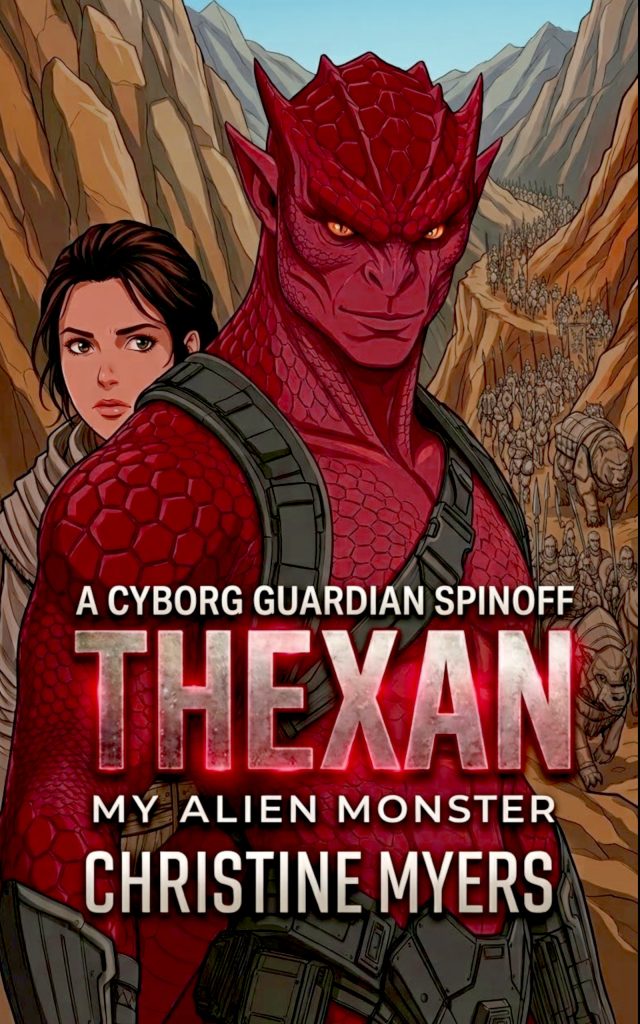
Releases to Kindle Unlimited on September 24th.
Chapter One
Brynn
The wound should have closed hours ago.
I pressed the folded cloth more firmly against his side and watched the blood seep through it anyway, darkening the fabric in slow, stubborn saturation. It didn’t surge the way a fresh injury might. It didn’t pulse cleanly with his heartbeat. It simply continued, steady and unrelenting, as though his body had forgotten how to stop.
“Stay with me,” I said quietly, more out of habit than expectation.
He didn’t respond.
His head rested at an angle that would have been uncomfortable if he were fully aware, the ridged structure of it catching the overhead light in hard lines that made it impossible to mistake him for anything human. There was no hair, no softness to obscure the underlying shape, only smooth, scaled surfaces broken by subtle plating that shifted slightly as his body fought to maintain control. Even now, even injured, there was nothing fragile about him.
A heavy tail lay partly off the side of the cot, scaled like the rest of him and still except for the occasional faint twitch when pain moved through him. I had been careful not to step on it while treating him, though the absurdity of that thought had nearly broken through my concentration more than once.
Alien warrior bleeding out on my cot, and I was worried about where to put his tail.
I shifted closer and set the soaked cloth aside, reaching for a clean one from the tray. The basin beside me had long since gone cloudy, tinged pink from repeated use. I dipped the cloth, wrung it out, and went back to the wound, working carefully to clear away what I could.
It wasn’t clean damage.
The edges were wrong—too precise in some places, too irregular in others—and whatever had caused it had burned and torn at the same time, leaving tissue that resisted every instinct I had built through years of treating injuries that made sense. The structure beneath my hands was denser than it should have been, the muscle layered differently, the heat of him running higher than any human baseline I had ever recorded.
Not human. Even his scent was different. It was a combination of mild-scented herbs and wet earth after rain—not unpleasant, just different.
That he was not human wasn’t a problem. It was just a fact I needed to work around. I had never treated his kind before.
The infirmary had been a school after the war and before my time. That war had changed everything into something else. Now this building held four cots in the old front classroom, a storage room I had turned into a supply closet, a second classroom we used when someone needed isolation or recovery, and a kitchen that still worked when the water lines cooperated. Behind it all was the narrow room I had claimed for myself, just large enough for a bed, a table, and the kind of privacy a settlement medic rarely got to use.
It served the entire settlement—small enough that I knew most of them by name, large enough that there was always someone needing something.
We were not equipped for this kind of trauma.
I exhaled slowly and reached for the coagulant, applying it with careful precision. His body reacted immediately, not with sound but with tension that moved through him all at once, a tightening beneath my hands that told me he was closer to awareness than I had assumed.
“Easy,” I said, lowering my voice without thinking.
For a moment, nothing changed. Then the tension eased—not fully, but enough that I could continue without fighting him.
I worked in silence, packing the wound and securing the bandage as best I could. It held. Not perfectly, but enough to give him a chance.
When I leaned back, I let out a breath I hadn’t realized I’d been holding and wiped my hands on a clean cloth, my mind already moving ahead to the next step.
He shouldn’t have made it this far. He hadn’t collapsed out in the settlement. He had reached the one place that might keep him alive—and then he’d stopped.
He hadn’t come through the central yard. Later, I would realize he must have followed the old drainage path behind the school, the one most people avoided because the ground dipped sharply and the brush grew thick against the rear wall. Injured or not, he had chosen the one route that kept him out of sight until he reached my door.
I could still see the way I’d found him when I closed my eyes—the heavy line of blood across the packed dirt outside the infirmary door, the way his body had been braced against the frame as if he had refused to fall until he had reached it. He hadn’t been fully conscious, but he hadn’t been gone either. When I’d told him to move, he had.
Barely.
Just enough that I could guide him.
Step by step, shifting his weight, forcing him to stay upright long enough to cross the threshold and reach the nearest cot before his body finally gave out under him. It hadn’t been strength that got him inside. It had been refusal—his and mine—to stop before it was accomplished.
I looked at him now, at the controlled stillness that had replaced that last effort, and wondered what had driven him to my door in the first place.
Then I stepped back to the cot and set my fingers lightly against his pulse.
It was strong.
Too strong.
The beat pressed against my fingertips with a force that didn’t match his condition, steady and insistent, as if his body were driving itself forward through will rather than stability. The texture beneath my touch was wrong in ways I was still adjusting to, the scaled surface holding heat differently, the structure beneath it less forgiving.
“That’s not right,” I murmured.
I leaned in slightly, concentrating on the rhythm beneath my fingers.
His hand moved.
Not fast enough to startle me into pulling away, but deliberate enough that I felt it before I fully registered it. His fingers closed around my wrist, the contact firm without being forceful, anchoring rather than restraining.
I stopped with my fingers still against his pulse.
His eyes remained closed, but the faint tightening along his jaw told me he was not as unaware as he looked. I watched his face, waiting to see whether he would surface or let me go.
The contact, however, changed something.
I felt it immediately.
My pulse shifted beneath his grip, the rhythm no longer entirely my own, heat spreading along my skin where he touched me in a way that had nothing to do with exertion or the warm air in the room. It wasn’t unpleasant. It wasn’t even painful, just unfamiliar.
I steadied my breathing before I answered him.
“Let go,” I said, keeping my voice even.
His fingers tightened slightly, though not enough to hurt. It was an answer, a silent refusal.
I exhaled softly through my nose, glancing briefly at his hand before returning my focus to the work in front of me.
“Fine,” I murmured. “We’ll do it this way.”
Instead of pulling free, I shifted my stance and continued the assessment with my other hand. Working around his grip as though it made no difference at all, I remained aware of the way my pulse had changed beneath his touch. The contact settled into my skin in a way I couldn’t ignore, not distracting enough to stop me, but present enough that I had to force my attention back where it belonged.
Little by little, the force of his heartbeat eased beneath my fingers until the relentless pressure became a rhythm I could believe his body might sustain.
It wasn’t just a consistent response—and that made it something I couldn’t ignore. I stilled, my concentration sharpening as I tracked the change. It was subtle but real.
My gaze shifted from his chest to his face, then briefly to where his hand circled my wrist before returning to study him more closely.
“Interesting,” I said under my breath.
I didn’t understand it yet. But I would. For now, he was alive, and I wasn’t letting him die.
Chapter Two
Thexan
Consciousness did not return all at once. It surfaced gradually, sensation layering over darkness until there was no longer any separation between the two.
Pain anchored me first.
It spread along my side in a steady, controlled burn, not sharp enough to disrupt awareness but persistent enough that I could not ignore it. The damage was deeper than the initial impact had suggested. My body was attempting repair, but the response was inefficient, the process slowed by disruption along my neural pathways.
I remained still long enough to let my senses recalibrate. Instinct urged me to rise, assess, eliminate. I refused it. Moving before I understood my condition would worsen the damage, and I had survived too much to make that error now.
The air was wrong.
Enclosed. Contained. Carrying the sterile traces of human habitation layered over older materials and worn structure. Not open terrain. Not a battlefield. Not any environment I had occupied in recent memory.
Human.
The recognition sharpened my focus.
I drew in a measured breath, filtering what I could through the residual distortion in my senses, and that was when I became aware of her.
Close.
Closer than any human should have been.
The response to her struck me immediately, bypassing conscious thought and striking at a level I had not felt since before the war had altered everything I understood about my own nature.
Protect.
The instinct aligned with something deeper, something embedded beyond discipline or conditioning.
My body answered her before thought could intervene. The impulse drove through me with a force unrelated to the wound, old and absolute. I held myself motionless until I could bring my attention back to her rather than the instinct demanding action.
Tension gathered along my muscles despite the injury that should have limited me, my awareness narrowing with a precision that left no room for distraction.
Her.
I opened my eyes.
Light resolved first, then the boundaries of the room. A quick assessment found no immediate threat. Only then did I turn my head, ignoring the pull of the wound, until I could see her clearly.
She was human.
There was no mistaking it at this distance, no confusion in the details my vision provided. Smaller in structure, unarmored, her skin smooth where mine was scaled, her movements precise but lacking the reinforcement my kind carried as a matter of design.
And yet none of that mattered.
The recognition struck fully this time, no longer restrained by incomplete awareness or distance.
She was mine.
The certainty arrived whole, leaving no space for argument.
Every muscle in me locked.
No.
No. Discipline answered as quickly as instinct had. My neural damage had weakened more than my body; it had stripped away some of the fine restraint I normally placed between impulse and action.
To acknowledge the bond in this condition, to allow it to influence my actions, would place her at risk.
That was not acceptable.
I forced the reaction down, containing it as best I could while I assessed her more closely. She was focused on the injury at my side, her attention fixed on the damage rather than the threat I presented. Her hands moved with measured confidence, applying pressure, and adjusting the treatment without hesitation.
She did not fear me, though she should have. That did not reassure me. It made her proximity more dangerous, because every instinct I possessed had begun to treat her nearness as necessary.
Distance was necessary. From her, from the bond that had already begun to assert itself, from the instability within my own system that I could not fully regulate. I understood that clearly enough, yet the response that followed did not come from a conscious decision. My hand moved before I could stop it, my fingers closing around her wrist with a precision that had nothing to do with intent and everything to do with need.
Her palm touched the center of my chest, and the disorder inside me changed at once.
The noise along my neural pathways drew inward toward that single point of contact. Pain remained, but clarity returned around it, enough that I could think without fighting my own body for every thought.
“You should not be here,” I said, my voice rough from disuse, the words slower than they should have been but controlled.
She did not retreat.
Her gaze remained on me, steady, assessing, as though she were evaluating the statement rather than reacting to it.
“With you?” she asked.
I met her eyes.
“Yes.”
The answer required no hesitation.
I expected her to move away. Any rational assessment of the situation would have led to that conclusion. Instead, she stepped closer, closing the distance I had just established as though my warning held no weight at all.
Before I could prevent it, her hand came to rest against my chest.
The contact was direct, unguarded, her palm pressing lightly against the center of my sternum.
Whatever restraint I had rebuilt gave way.
This time the change ran deeper. The tension in my body loosened despite the wound, and breath came without effort for the first time since I woke.
I drew in a breath.
It came easily.
More easily than it had since I regained awareness.
For several heartbeats, all I could comprehend was the impossible fact of her trust. She had stepped closer when every rational response should have sent her away, and something in me answered to that choice with a need that had nothing to do with injury.
Something moved through me that did not belong to pain, injury, or neural disruption.
It was need, sharpened by the knowledge that she had placed herself within reach of a male she should have feared and had done it because she chose to understand instead.
I looked from her hand on my chest to her face. What she was to me no longer felt like a conclusion I had reached; it felt like a fact my body had recognized before my mind was willing to name it.
She was not only stabilizing me.
She was becoming the point around which every other calculation altered.
That realization should have brought clarity.
Instead, it produced something dangerously close to fear.
Not for myself.
For her.
This changed everything.
And in my current state, I did not yet know whether that would ensure her survival—
Or guarantee her destruction.
Chapter Three
Brynn
His warning should have made me move away.
For one heartbeat, I almost did.
Every sensible instinct I had told me to put distance between us, to listen when a wounded alien warrior looked me in the eyes and told me I was in danger. But my hand was still against his chest, and beneath my palm, his breathing had changed. The tension that had been locking his body in place had eased. His pulse no longer felt like it was trying to tear through him.
Whatever was happening, my touch was helping.
And he hadn’t warned me like a man making a threat.
He had warned me like a man fighting himself.
So I stayed.
I kept my hand against the center of his chest, feeling the strange, structured heat of him beneath my palm while I watched his face for any change that might tell me whether I had made the wrong decision. There were ridges along his brow and cheekbones, subtle but unmistakable, catching the infirmary light in a way no human bone structure ever would. His skin was not skin the way mine was. Up close, it had a scaled texture, smooth in some places, faintly plated in others, with a density beneath it that made my hand feel too human, too soft, too breakable by comparison.
And yet he was the one lying on my cot, bleeding through a bandage I had already changed twice.
“You said I was in danger from you,” I said, keeping my voice even because his body had gone dangerously still beneath my touch. “Are you warning me because you intend to hurt me, or because you’re afraid you might?”
His eyes remained on mine. They were not human either. I had known that before, but awareness and direct confrontation were two different things. In the dim light they looked almost golden, though that didn’t fully describe them. There was too much depth, too much contained intensity, as if some inner heat still burned behind the exhaustion and pain.
“I do not intend harm,” he said.
The words came rough, shaped with effort, but his meaning was clear enough.
“Then we’ll start there.”
His chest moved under my palm as he drew in a slow breath. I felt the movement before I heard it, the controlled expansion of a body built with more strength than anything I had treated before. The tremor that followed was slight, almost hidden, but I caught it anyway because I had been watching him too closely not to.
“You should remove your hand.”
“I probably should,” I agreed.
I didn’t.
His fingers loosened from my wrist by slow degrees, not because he wanted to let go, but because he had decided to. The release should have made the contact between us less intense.
It didn’t.
If anything, my palm against his chest felt more deliberate now that he was no longer holding me there.
The corner of his mouth tightened, not quite in pain and not quite in impatience. “Human female—”
“Brynn,” I interrupted.
He stared at me as if I had given him something he did not know what to do with.
“My name is Brynn Ellison. If you’re going to keep warning me that I’m in danger while lying half-conscious in my infirmary, you can at least use my name.”
I thought he might refuse. Instead, his attention fixed more sharply on me.
“Thexan.”
The sound of it moved through the room differently than a human name would have. Low. Precise. Foreign enough that I knew I would remember it.
“Thexan,” I repeated, testing the shape of it carefully.
Something changed in him when I said it. Not visibly, not enough that anyone else might have noticed, but I was close enough to feel the response beneath my hand. His breathing deepened by a fraction, and the hard tension through his chest eased before he seemed to realize it had happened.
I looked down at my hand, then back at him.
“That helps too.”
His eyes narrowed. “What helps?”
“Contact.” I shifted my palm slightly, not pressing harder, only adjusting to feel the rhythm beneath it. “Your pulse was too strong before. Too forceful. Not fast exactly, but wrong. When you grabbed my wrist, it started to settle. When I touched your chest, your breathing improved.”
“That does not mean you should continue.”
“No, but it does mean I need to understand why.”
“You do not.”
That was almost enough to make me smile, though I was too tired and too concerned to let it reach my face. “You don’t know me well enough to tell me what I need to understand.”
“I know enough.”
“You know I’m human. That’s not the same thing.”
His gaze moved over me then, more assessing than before, and I had the unsettling sense that he was cataloging me with the same precision I had been trying to apply to him. I should have been uncomfortable under that scrutiny. Maybe I was, but not in a way that made me want to retreat. The awareness of him was too strong, filling the small infirmary until the familiar room no longer felt quite like mine.
I removed my hand from his chest.
The reaction was immediate.
His body tightened, and though he controlled the response quickly, I saw enough. More importantly, I felt the change in the air between us, as if a thread had pulled taut the instant contact broke.
I set my fingers against his wrist instead, because I wanted to know whether the effect depended on location or simply on touch.
His breath left him slowly.
“All right,” I murmured. “Not just the chest.”
“Brynn.”
My name in his voice should not have affected me the way it did. It was too rough, too strained, shaped by an alien mouth and a body still fighting shock, but the sound settled under my skin all the same.
I forced my attention back to his pulse.
“You’re improving when I touch you,” I said. “You deteriorate when I don’t. I don’t have to know why yet to recognize the pattern.”
“You should not rely on a pattern you do not understand.”
“I agree. That’s why I’m still collecting information.”
His fingers flexed once beneath mine, but he did not pull away. “You are not afraid enough.”
“I’m exhausted,” I said honestly. “Sometimes that looks the same.”
For the first time, something almost like confusion crossed his face.
I let out a breath and reached for the diagnostic tablet on the tray beside the cot. Most of its functions were unreliable when used on anyone outside the human baseline, but it could still record temperature, pulse pressure, respiratory shifts, and electrical irregularities if I adjusted the settings manually. I had repaired it twice with scavenged parts and sheer refusal to let another useful thing die. It flickered when I activated it, then steadied.
“Try not to move.”
“I am injured, not undisciplined.”
“That remains to be seen.”
His gaze fixed on me again, and this time the silence carried something different, a faint undercurrent that might have been irritation if he had been human. I found that oddly reassuring. A patient annoyed with me was usually less likely to die in the next five minutes.
I ran the scan slowly, adjusting the angle when the diagnostic tablet protested the density of his body. The readings came back uneven, some useless, some fascinating. Elevated temperature. Irregular neural activity. Cardiovascular force far beyond human tolerance. Tissue damage along the wound site complicated by an energy residue I could not identify.
“What did this?” I asked.
His expression closed.
That was answer enough.
“Thexan.”
The name worked again. His attention returned to me, immediate and intense.
“I need to know if whatever hurt you is going to kill you while I’m standing here guessing.”
“The weapon was designed to disrupt repair response.”
I looked down at the wound. “That explains why it keeps reopening.”
“It also disrupts neural regulation.”
My gaze lifted. “That explains the instability.”
“Yes.”
“And the contact?”
He looked away.
Not far. Only enough that he was no longer meeting my eyes.
That, more than anything, made my hand still over the diagnostic tablet. I didn’t like not understanding something this fundamental—especially when it involved my own body as much as his.
“You know what this is.”
He did not answer immediately. The quiet stretched between us, filled with the low hum of the overhead light and the distant sound of someone laughing outside the infirmary, oblivious to the fact that I had an injured Mesaarkan warrior on my cot and no idea whether I had just saved my settlement or invited danger into the center of it.
“I know enough,” he said at last.
“That’s becoming a very annoying answer.”
“It is the only one I can give you safely.”
I set the tablet down with more care than I felt. “Then give me the unsafe one.”
His eyes returned to mine.
The room seemed to narrow again.
The room narrowed to details: blood beneath my nails, the ache between my shoulders, the heat of his wrist under my fingers, the shallow rise of his bandaged chest, and the impossible steadiness of his eyes on mine.
Then he said, “My body recognizes you.”
The words should have been meaningless without context. They weren’t. I didn’t understand them, but some part of me reacted before thought could intervene, a small tightening low in my body, a warmth that had nothing to do with the infirmary or exhaustion.
I made myself breathe normally.
“As what?”
His answer came slowly, as if each word required discipline.
“As necessary.”
The answer gave me a category without giving me meaning.
I looked down at the place where my fingers still rested against his wrist. His pulse had steadied further, the earlier force easing into a rhythm that no longer felt as if his body were trying to tear itself apart from the inside.
“And that makes me dangerous to you?” I asked.
“No.”
“To myself?”
His jaw tightened. “Potentially.”
I stared at him.
That was it.
That was the point where whatever patience I had left thinned past usefulness. He was bleeding on my cot, responding to my touch in ways neither of us could ignore, warning me in fragments, and now apparently there were enemies somewhere beyond my door who might be moving toward a settlement full of people who had no idea danger was coming.
I pulled in a breath and let it out slowly.
“Thexan,” I said, keeping my voice level by force, “what the hell is going on?”
His attention snapped fully to me.
“I need more than yes, no, and potentially,” I continued. “I need to know what this is, what you are, and whether everyone outside this room is in danger because you came here.”
He let the question hang between us before answering.
Then the surrounding air seemed to harden.
“Yes,” he said. “They are in danger.”
The answer landed cold.
“Who is they?”
“The ones tracking me.”
“How close?”
“I do not know.”
“How many?”
“I do not know that either.”
“But they’re dangerous.”
“Yes.” His eyes held mine, and this time he did not leave the answer there. “They are trained to remove threats without hesitation. If they find me here, they will not spare this structure because it contains civilians. They will not spare you because you lack information. They will evaluate proximity, interference, and usefulness. If you have aided me, you become a variable. Variables are removed.”
I closed my eyes briefly, because my mind needed one quiet second to rearrange the shape of the problem.
An unknown number of dangerous Mesaarkans—or something close enough to them to wound him—might be tracking him toward a settlement full of exhausted people with patched walls, aging weapons, and more courage than training.
When I opened my eyes, he was watching me.
“You should alert your leaders,” he said. “They should evacuate this structure and move your people away from me.”
“That would expose you.”
“Yes.”
“And if your enemies find you before you can stand?”
His expression did not change, but the stillness in him shifted into something colder.
“Then the threat remains concentrated on me.”
I stared at him. “You mean you die before they reach anyone else.”
“If I cannot move, that is the most efficient outcome.”
“No.”
His eyes hardened. “You do not understand.”
“I understand enough to know that men who say things like that are usually trying to make dying sound practical.”
“It is practical,” he said, rougher now. “It is not preferred.”
That stopped me.
For the first time, I heard something beneath the calculation. Not fear exactly. Not for himself. Something tighter than that.
“You don’t want to die,” I said.
“No.”
The answer was immediate this time.
“And yet you’re telling me to let it happen.”
“I am telling you to protect your people.”
“It’s also inconvenient,” I said, because if I let the moment get any heavier, I might feel it too much. “Since I just spent a great deal of effort keeping you alive.”
That should not have mattered to him.
I saw that it did.
Not much. Not in any way he would willingly show. But something in his face shifted, a minute change around the eyes, a softening so brief I might have imagined it if I had not been watching him with the focus of a woman trying to keep him from bleeding out on her cot.
I drew another breath and made the decision before I could talk myself out of it.
“You’re staying here tonight.”
“No.”
“Yes.”
“Brynn—”
“You cannot stand without tearing that wound open. Your neural regulation is unstable. Your body responds positively to proximity, which means sending you away would be medically stupid even if it were morally convenient. I’m not doing it.”
“You place yourself at risk.”
“I place myself at risk every time someone drags a half-dead stranger to my door.”
“I am not a stranger to your kind.”
“No,” I said, glancing over the scaled structure of his chest and the ridged planes of his face. “You definitely are not.”
His mouth tightened again, and this time I was almost certain it would have been a grim smile on anyone else.
I stepped away only long enough to retrieve a clean blanket from the storage cabinet. The moment distance opened between us, I heard his breathing change. He controlled it quickly, but not quickly enough. I turned back and found him staring at the ceiling, every line of his body held in rigid restraint.
“You feel that when I move away.”
“Yes.”
The honesty surprised me.
I returned to the cot and spread the blanket carefully over him, avoiding the wound. “Does it hurt?”
“Not physically.”
That answer stayed with me.
I should have asked more. I should have demanded a full explanation, one that included every risk he had not yet named. Instead, I found myself studying the controlled tension in his face and the way his fingers had curled against the blanket, not reaching for me, not asking, but fighting the need to do both.
For reasons I did not want to examine too closely, that mattered.
I sat in the chair beside the cot and rested my hand lightly against his forearm.
His eyes closed.
The effect was quiet this time, but no less real. The tension eased from him gradually, not disappearing but settling into something his body could bear. I watched the change with the same clinical attention I had given the wound, though there was nothing clinical about the way my own pulse responded.
“This is temporary,” I said, though I wasn’t sure whether I meant the treatment, his presence in my infirmary, or the strange connection tightening between us.
His eyes opened again.
“No,” he said softly. “It is not.”
I held his gaze, and for the first time since I had found him at the ridge, I let myself consider the possibility that the danger he represented was not the only reason I couldn’t make myself step away.
Then someone knocked hard on the infirmary door.
I stood too quickly, and his hand caught mine before I had taken a full step. This time, there was no unconsciousness to excuse it. His fingers closed around mine with controlled urgency, and his voice dropped lower than before.
“Do not open it until you know who stands outside.”
I looked toward the door, then back at him.
The knock came again.
“Brynn?” Tanner called from the other side. “You in there? We found blood on the lower ridge.”
Thexan’s grip tightened around my hand.
Not painfully.
Protectively.
And every instinct I had told me that whatever had followed him into my mountains had already begun to arrive.
End of sample.